
|
You entered: Earth orbit
 The Decade that Defined Star System
28.12.1999
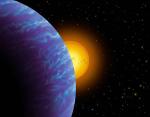
As the 1990s began, the only planetary star system known was our own Solar System. The first extra-solar star system was discovered orbiting a pulsar in 1991. Slight changes in the precise arrival times of the pulses from the central small dense neutron star gave evidence of orbiting planets.
 The North and South Jupiter
13.09.2016
A wide, looping orbit brought Juno close to Jupiter on August 27. As the spacecraft swung around the giant planet's poles JunoCam acquired these premier direct polar views, a change from the usual nearly equatorial perspective of outbound spacecraft and the telescopes of planet Earth.
 APOD: 2025 November 16 Б Crossing Saturns Ring Plane
15.11.2025
If this is Saturn, where are the rings? When Saturn's "appendages" disappeared in 1612, Galileo did not understand why. Later that century, it became understood that Saturn's unusual protrusions were rings and that when the Earth crosses the ring plane, the edge-on rings will appear to disappear.
 Enhanced Color Caloris
4.03.2015
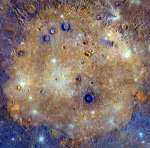
The sprawling Caloris basin on Mercury is one of the solar system's largest impact basins, created during the early history of the solar system by the impact of a large asteroid-sized body.
 Spokes Reappear on Saturns Rings
2.06.2009
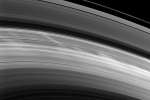
What causes the mysterious spokes in Saturn's rings? Visible in the above image as light ghostlike impressions, spokes were first discovered by the Voyager spacecraft that buzzed by Saturn in the early 1980s. Their existence was unexpected.
 Io at Sunset
19.01.2003
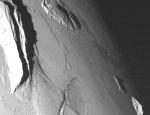
How tall are mountains on Jupiter's moon Io? One way to find out is to view them at sunset. Tall structures facing the Sun are then better-lit and cast long shadows. The above...
 A Big Cliff on Jupiter's Callisto
17.02.1997
Callisto's surface is not without fault. In fact, an explorer crossing the surface of this large moon of Jupiter would need climbing equipment to pass this large, recently discovered fault. The above picture was released last week and was taken in November 1996 by the robot spacecraft Galileo currently orbiting Jupiter.
 Cassini To Saturn
29.08.1997
Scheduled for launch in October, the Cassini spacecraft will spend seven years traveling through the Solar System -- its destination, Saturn. On arrival Cassini will begin an ambitious mission of exploration which will include parachuting a probe to the surface of Titan, Saturn's largest moon.
 Comet PanSTARRs and the Galaxies
5.06.2020
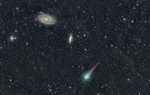
Comet PanSTARRs, C/2017 T2, shared this stunning telescopic field of view with galaxies M81 and M82 on May 22/23. Of course, the galaxies were some 12 million light-years distant and the comet about 14 light-minutes away, seen in planet Earth's sky toward the Big Dipper.
 APOD: 2024 June 4 Б Comet Pons Brooks Develops Opposing Tails
3.06.2024
Why does Comet Pons-Brooks now have tails pointing in opposite directions? The most spectacular tail is the blue-glowing ion tail that is visible flowing down the image. The ion tail is pushed directly out from the Sun by the solar wind. On the upper right is the glowing central coma of Comet 12P/PonsБBrooks.
|
January February March April May June July August September October |
|||||||||||||||||||||||||||||||||||||||||||||||||