
|
You entered: Moon
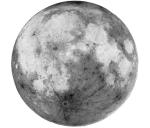 Full Moondark
12.12.2003
The brilliant full Moon might not have looked quite like this to skygazers this week, but the image is a mosaic of 18 digital frames recorded on December 9th at 3:30 UT.
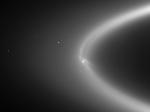 Enceladus Creates Saturns E Ring
27.03.2007
The active moon Enceladus appears to be making Saturn's E ring. An amazing picture showing the moon at work was taken late last year by the Saturn-orbiting Cassini spacecraft and is shown above. Enceladus is the bright point near the center, right near the center of Saturn's E ring.
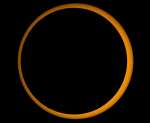 Annular Solar Eclipse
19.05.2012
Tomorrow, May 20, the Moon's shadow will race across planet Earth. Observers within the 240-300 kilometer wide shadow track will be able to witness an annular solar eclipse as the Moon's apparent size is presently too small to completely cover the Sun.
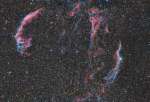 Wisps of the Veil Nebula
26.11.2012
Wisps like this are all that remain visible of a Milky Way star. About 9,000 years ago that star exploded in a supernova leaving the Veil Nebula, also known as the Cygnus Loop.
 Lunar Farside
5.04.2014
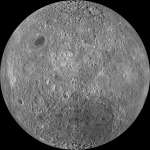
Tidally locked in synchronous rotation, the Moon always presents its familiar nearside to denizens of planet Earth. From lunar orbit, the Moon's farside can become familiar, though. In fact this sharp picture, a mosaic from the Lunar Reconnaissance Orbiter's wide angle camera, is centered on the lunar farside.
 Charon
17.07.2015
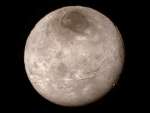
Icy world Charon is 1,200 kilometers across. That makes Pluto's largest moon only about 1/10th the size of planet Earth but a whopping 1/2 the diameter of Pluto itself. Charon is seen in unprecedented detail in this image from New Horizons.
 Lunar Farside
30.12.2016
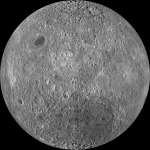
Tidally locked in synchronous rotation, the Moon always presents its familiar nearside to denizens of planet Earth. From lunar orbit, the Moon's farside can become familiar, though. In fact this sharp picture, a mosaic from the Lunar Reconnaissance Orbiter's wide angle camera, is centered on the lunar farside.
 Firefall by Moonlight
8.06.2017
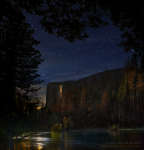
On certain dates in February, an elusive firefall can be spotted at sunset in Yosemite National Park, when the weather cooperates and the direction to the setting Sun is just right. Often photographed from...
 Planetary Alignment over Italy
19.12.2021
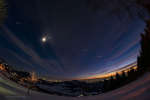
It is not a coincidence that planets line up. That's because all of the planets orbit the Sun in (nearly) a single sheet called the plane of the ecliptic. When viewed from inside that plane -- as Earth dwellers are likely to do -- the planets all appear confined to a single band.
 Movie: Cassini Crosses Saturns Ring Plane
31.01.2007
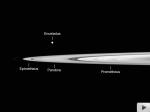
What would the rings of Saturn look like if you passed right through the ring plane? To find out, NASA aimed cameras from the Cassini spacecraft right at Saturn's rings as the robotic explorer passed from the sunlit side of the rings to the shadowed side.
|
January February March April May June July August September October |
|||||||||||||||||||||||||||||||||||||||||||||||||