
|
You entered: gas
 APOD: 2025 December 9 Б The Heart of the Soul Nebula
9.12.2025
This cosmic close-up looks deep inside the Soul Nebula. The dark and brooding dust clouds outlined by bright ridges of glowing gas are cataloged as IC 1871. About 25 light-years across, the telescopic field of view spans only a small part of the much larger Heart and Soul nebulae.
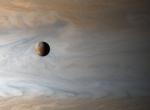 Io: Moon Over Jupiter
20.04.2001
How big is the Jovian moon Io? The most volcanic body in the Solar System, Io (usually pronounced "EYE-oh") is 3,600 kilometers in diameter, about the size of planet Earth's single large natural satellite.
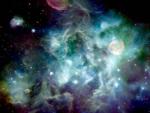 A Radio Vista of Cygnus
18.02.2002
Shells of ancient supernovas, cocoons surrounding newborn stars, and specks from distant quasars highlight this tremendous vista toward the constellation of Cygnus. The representative color image covers about 10 degrees across on the sky but is only a small part of the Canadian Galactic Plane Survey in radio light.
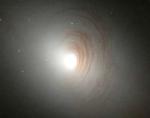 NGC 2787: A Barred Lenticular Galaxy
8.04.2002
Lenticular galaxies aren't supposed to be photogenic. Like spiral galaxies, they contain a disk, but like elliptical galaxies, they are usually short on dust, gas, and pretty spiral arms. Lenticulars are relatively little studied, possibly because of their seemingly benign nature. Famous galaxies historically classified as lenticular include M84, M85, and M86.
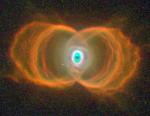 MyCn18: An Hourglass Nebula
15.06.2002
The sands of time are running out for the central star of this hourglass-shaped planetary nebula. With its nuclear fuel exhausted, this brief, spectacular, closing phase of a Sun-like star's life occurs as its outer layers are ejected - its core becoming a cooling, fading white dwarf.
 Jupiter from Voyager
25.06.1995
Imagine a hurricane that lasted for 300 years! This picture of the planet Jupiter was taken by the Voyager 1 spacecraft as it passed the planet in 1979. Jupiter, a gas giant planet with no solid surface, is the largest planet in the solar system and is made mostly of the hydrogen and helium.
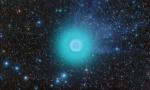 Comet Holmes Grows a Tail
5.11.2007
Comet Holmes continues to be an impressive sight to the unaided eye. The comet has diminished in brightness only slightly, and now clearly appears to have a larger angular extent than stars and planets. Astrophotographers have also noted a distinctly green appearance to the comet's coma over the past week.
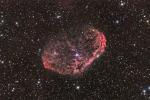 NGC 6888: The Crescent Nebula
11.11.2007
What caused the Crescent Nebula? Looking like an emerging space cocoon, the Crescent Nebula, visible in the center of the above image, was created by the brightest star in its center. A leading progenitor hypothesis has the Crescent Nebula beginning to form about 250,000 years ago.
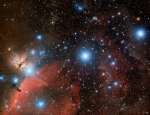 Alnitak, Alnilam, Mintaka
21.01.2011
Alnitak, Alnilam, and Mintaka, are the bright bluish stars from east to west (left to right) along the diagonal in this gorgeous cosmic vista. Otherwise known as the Belt of Orion, these three blue supergiant stars are hotter and much more massive than the Sun.
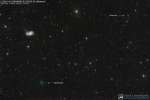 Whirlpool with Comets
8.12.2016
Not a comet, bright spiral galaxy Messier 51 is popularly known as the Whirlpool Galaxy. Just off the handle of the Big Dipper in northern skies, you can spot it at the upper left in this image from December 1st. The pretty 4 by 2.5 degree wide field of view does contain two comets though.
|
January February March April May June July August September October |
|||||||||||||||||||||||||||||||||||||||||||||||||