
|
You entered: star cluster
 APOD: 2026 April 29 Б The Moon, Venus, and the Pleiades
28.04.2026
No, Earth did not recently acquire six more moons! TodayБs APOD is a combination of images following the Moon, Venus, and the Pleiades across a southern Sicilian sky as twilight turned to evening on April 19.
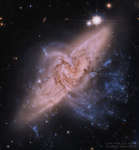 NGC 3314: When Galaxies Overlap
16.11.2021
Why doesn't the nearby galaxy create a gravitational lensing effect on the background galaxy? It does, but since both galaxies are so nearby, the angular shift is much smaller than the angular sizes of the galaxies themselves.
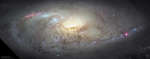 M106 Close Up
3.10.2013
Close to the Great Bear (Ursa Major) and surrounded by the stars of the Hunting Dogs (Canes Venatici), this celestial wonder was discovered in 1781 by the metric French astronomer Pierre Mechain. Later, it was added to the catalog of his friend and colleague Charles Messier as M106.
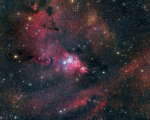 Cosmic Clouds in the Unicorn
7.02.2020
Interstellar clouds of hydrogen gas and dust abound in this gorgeous skyscape. The 3 degree wide field of view stretches through the faint but fanciful constellation Monoceros, the Unicorn. A star forming region cataloged as NGC 2264 is centered, a complex jumble of cosmic gas, dust and stars about 2,700 light-years distant.
 Breaking Distant Light
3.01.2009
In the distant universe, time appears to run slow. Since time-dilated light appears shifted toward the red end of the spectrum (redshifted), astronomers are able to use cosmological time-slowing to help measure vast distances in the universe.
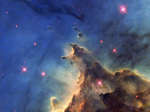 NGC 2174: Stars Versus Mountains
8.02.2011
It's stars versus gas mountains in NGC 2174 and the stars are winning. More precisely, the energetic light and winds from massive newly formed stars are evaporating and dispersing the dark stellar nurseries in which they formed.
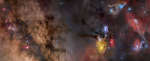 From the Galactic Plane through Antares
1.07.2018
Behold one of the most photogenic regions of the night sky, captured impressively. Featured, the band of our Milky Way Galaxy runs diagonally along the far left, while the colorful Rho Ophiuchus region including...
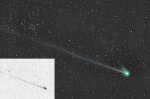 Comet McNaught Passes NGC 1245
17.06.2010
Of the many comets named for discoverer Robert McNaught, the one cataloged as C/2009 R1 is gracing dawn skies for northern hemisphere observers this month. Seen here on June 13th from southern New Mexico, this Comet McNaught's long ion tail sweeps across the telescopic field of view (a negative image is inset).
 APOD: 2020 August 26 Б Cygnus Skyscape
25.08.2020
In brush strokes of interstellar dust and glowing hydrogen gas, this beautiful skyscape is painted across the plane of our Milky Way Galaxy near the northern end of the Great Rift and the constellation Cygnus the Swan.
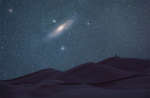 Andromeda over the Sahara Desert
10.07.2022
What is the oldest thing you can see? At 2.5 million light years distant, the answer for the unaided eye is the Andromeda galaxy, because its photons are 2.5 million years old when they reach you.
|
January February March April May June July August September October |
|||||||||||||||||||||||||||||||||||||||||||||||||