
|
You entered: surface
 Explosions from White Dwarf Star RS Oph
22.08.2021
Spectacular explosions keep occurring in the binary star system named RS Ophiuchi. Every 20 years or so, the red giant star dumps enough hydrogen gas onto its companion white dwarf star to set off a brilliant thermonuclear explosion on the white dwarf's surface.
 The Snows of Churyumov Gerasimenko
6.01.2024
You couldn't really be caught in this blizzard while standing by a cliff on periodic comet 67P/Churyumov-Gerasimenko. Orbiting the comet in June of 2016, the Rosetta spacecraft's narrow angle camera did record...
 APOD: 2025 June 29 Б Dark Sand Cascades on Mars
29.06.2025
Are these trees growing on Mars? No. Groups of dark brown streaks have been photographed by the Mars Reconnaissance Orbiter on melting pinkish sand dunes covered with light frost. The featured image was taken in 2008 April near the North Pole of Mars.
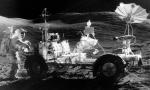 Apollo 17 s Lunar Rover
9.06.2001
In December of 1972, Apollo 17 astronauts Eugene Cernan and Harrison Schmitt spent about 75 hours exploring the Moon's Taurus-Littrow valley while colleague Ronald Evans orbited overhead. Cernan and Schmitt were the last humans to walk or ride on the Moon - aided in their explorations by a Lunar Roving Vehicle.
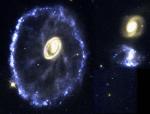 Cartwheel Of Fortune
19.12.1998
By chance, a collision of two galaxies has created a surprisingly recognizable shape on a cosmic scale - "The Cartwheel Galaxy". The Cartwheel is part of a group of galaxies about 500 million light years away in the constellation Sculptor (two smaller galaxies in the group are visible on the right).
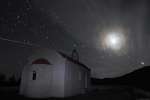 Atlantis over Rhodes
28.05.2010
A moonlit chapel stands in the foreground of this night-scape from the historic Greek island of Rhodes. The tantalizing sky above features a colorful lunar corona, where bright moonlight is diffracted by water droplets in the thin clouds drifting in front of the lunar disk.
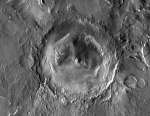 Gale Crater
29.07.2011
This sharp view from the Thermal Emission Imaging System camera on NASA's Mars Odyssey orbiter is centered on 154 kilometer (96 mile) wide Gale crater, near the martian equator. Within Gale, an impressive layered mountain rises about 5 kilometers (3 miles) above the crater floor.
 Flying Past Neptunes Moon Triton
26.08.2014
What would it look like to fly past Triton, the largest moon of planet Neptune? Only one spacecraft has ever done this -- and now, for the first time, images of this dramatic encounter have been gathered into a movie. On 1989 August 25, the Voyager 2 spacecraft shot through the Neptune system with cameras blazing.
 The Space Station Crosses a Spotless Sun
15.07.2019
That's no sunspot. It's the International Space Station (ISS) caught passing in front of the Sun. Sunspots, individually, have a dark central umbra, a lighter surrounding penumbra, and no solar panels. By contrast, the ISS is a complex and multi-spired mechanism, one of the largest and most sophisticated machines ever created by humanity.
 APOD: 2025 February 12 Б Asteroid Bennu Holds the Building Blocks of Life
12.02.2025
What can a space rock tell us about life on Earth? NASA's OSIRIS-REx spacecraft made a careful approach to the near-Earth asteroid 101955 Bennu in October of 2020 to collect surface samples. In September 2023, the robotic spaceship returned these samples to Earth.
|
January February March April May June July August September October |
|||||||||||||||||||||||||||||||||||||||||||||||||