
|
You entered: constellation
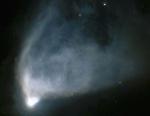 NGC 2261: Hubbles Variable Nebula
20.10.1999
What causes Hubble's Variable Nebula to vary? The unusual nebula pictured above changes its appearance noticeably in just a few weeks. Discovered over 200 years ago and subsequently cataloged as NGC 2661, the remarkable nebula is named for Edwin Hubble, who studied it earlier this century.
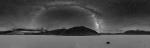 A Dark Sky over Death Valley
8.05.2007
This eerie glow over Death Valley is in danger. Scrolling right will show a spectacular view from one of the darkest places left in the continental USA: Death Valley, California. The above 360-degree full-sky panorama is a composite of 30 images taken two years ago in Racetrack Playa.
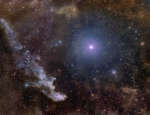 Rigel and the Witch Head Nebula
28.12.2009
Double, double toil and trouble; Fire burn, and cauldron bubble -- maybe Macbeth should have consulted the Witch Head Nebula. This suggestively shaped reflection nebula on the lower left is associated with the bright star Rigel, to its right, in the constellation Orion.
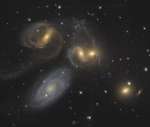 Stephan s Quintet
19.11.2010
The first identified compact galaxy group, Stephan's Quintet is featured in this eye-catching image constructed with data drawn from the extensive Hubble Legacy Archive. About 300 million light-years away, only four galaxies of the group are actually locked in a cosmic dance of repeated close encounters.
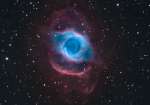 NGC 7293: The Helix Nebula
4.10.2012
A mere seven hundred light years from Earth, in the constellation Aquarius, a sun-like star is dying. Its last few thousand years have produced the Helix Nebula (NGC 7293), a well studied and nearby example of a Planetary Nebula, typical of this final phase of stellar evolution.
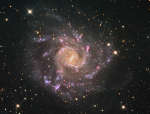 Grand Spiral Galaxy NGC 7424
8.01.2013
The grand, winding arms are almost mesmerizing in this face-on view of NGC 7424, a spiral galaxy with a prominent central bar. About 40 million light-years distant in the headlong constellation Grus, this island universe is also about 100,000 light-years across making it remarkably similar to our own Milky Way.
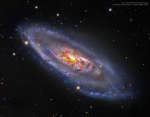 M106: A Spiral Galaxy with a Strange Center
15.02.2015
What's happening at the center of spiral galaxy M106? A swirling disk of stars and gas, M106's appearance is dominated by blue spiral arms and red dust lanes near the nucleus, as shown in the featured image.
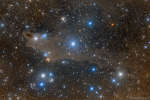 The Shark Nebula
6.09.2015
There is no sea on Earth large enough to contain the Shark nebula. This predator apparition poses us no danger, though, as it is composed only of interstellar gas and dust. Dark dust like that featured here is somewhat like cigarette smoke and created in the cool atmospheres of giant stars.
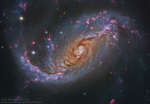 NGC 1672: Barred Spiral Galaxy from Hubble
12.09.2016
Many spiral galaxies have bars across their centers. Even our own Milky Way Galaxy is thought to have a modest central bar. Prominently barred spiral galaxy NGC 1672, featured here, was captured in spectacular detail in an image taken by the orbiting Hubble Space Telescope.
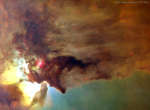 In the Center of the Lagoon Nebula
20.05.2017
The center of the Lagoon Nebula is a whirlwind of spectacular star formation. Visible on the lower left, at least two long funnel-shaped clouds, each roughly half a light-year long, have been formed by extreme stellar winds and intense energetic starlight. The tremendously bright nearby star, Hershel 36, lights the area.
|
January February March April May June July August September October |
|||||||||||||||||||||||||||||||||||||||||||||||||