
|
You entered: nearest stars
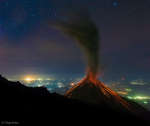 Volcano of Fire Erupts Under the Stars
10.03.2015
First, there was an unusual smell. Then there was a loud bang. But what appeared to the eye was the most amazing of all. While waiting near midnight to see a possible eruption of VolcАn de Fuego (Volcano of Fire) in Guatemala last month, a ready camera captured this extraordinary image.
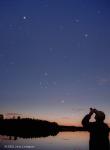 Dusk of the Planets
29.04.2002
A great grouping of planets is now visible to the west just after sunset. Over the next two weeks, Mercury, Venus, Earth, Mars, Jupiter, and Saturn -- all the planets of the inner Solar System -- can be seen in a single knowing glance. The image on the left captured them all in one frame.
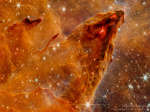 M16: A Star Forming Pillar from Webb
6.12.2022
WhatБs happening inside this interstellar mountain? Stars are forming. The mountain is actually a column of gas and dust in the picturesque Eagle Nebula (M16). A pillar like this is so low in density that you could easily fly though it -- it only appears solid because of its high dust content and great depth.
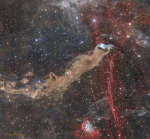 Wolfs Cave Nebula
15.11.2022
The mysterious blue reflection nebula found in catalogs as VdB 152 or Ced 201 really is very faint. It lies at the tip of the long dark nebula Barnard 175 in a dusty complex that has also been called Wolf's Cave.
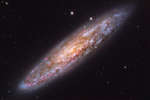 NGC 253: Dusty Island Universe
6.11.2025
Shiny NGC 253 is one of the brightest spiral galaxies visible, and also one of the dustiest. Some call it the Silver Coin Galaxy for its appearance in small telescopes, or just the Sculptor Galaxy for its location within the boundaries of the southern constellation Sculptor.
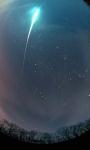 A Leonid Bolide Over Kansas
25.11.1998
The 1998 Leonid Meteor Shower featured many bright events. Extremely bright meteors, known as bolides or fireballs, can briefly glow brighter than the full moon. Pictured above is a Leonid bolide caught during a five-minute, wide-angle exposure. The bolide was so bright it lit up the surrounding area, making otherwise dark trees visible.
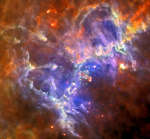 Inside the Eagle Nebula
3.02.2012
In 1995, a now famous picture from the Hubble Space Telescope featured Pillars of Creation, star forming columns of cold gas and dust light-years long inside M16, the Eagle Nebula. This remarkable false-color composite image revisits the nearby stellar nursery with image data from the orbiting Herschel Space Observatory and XMM-Newton telescopes.
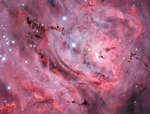 The Deep Lagoon
29.07.2015
Ridges of glowing interstellar gas and dark dust clouds inhabit the turbulent, cosmic depths of the Lagoon Nebula. Also known as M8, The bright star forming region is about 5,000 light-years distant.
 APOD: 2024 December 15 Б Geminid Meteors over a Snowy Forest
15.12.2024
Meteors have been flowing out from the constellation Gemini. This was expected, as mid-December is the time of the Geminid Meteor Shower. Pictured here, over two dozen meteors were caught in successively added exposures taken over several hours early Saturday morning from a snowy forest in Poland.
 Brighter Than Mars
27.08.2010
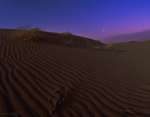
Even though you may have just read an email claiming Mars will be incredibly bright tonight, the brightest star on the horizon is not Mars. From central Iran on August 24th, the brightest star in this twilight desert skyview is Venus, aka the Evening Star.
|
January February March April May June July August September |
|||||||||||||||||||||||||||||||||||||||||||||||||