
|
You entered: time
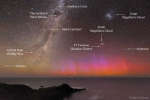 Red Aurora Over Australia
28.01.2017
Why would the sky glow red? Aurora. A solar storm in 2012, emanating mostly from active sunspot region 1402, showered particles on the Earth that excited oxygen atoms high in the Earth's atmosphere. As the excited element's electrons fell back to their ground state, they emitted a red glow.
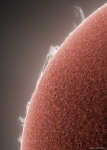 Active Prominences on a Quiet Sun
19.08.2018
Why is the Sun so quiet? As the Sun enters into a period of time known as a Solar Minimum, it is, as expected, showing fewer sunspots and active regions than usual. The quietness is somewhat unsettling, though, as so far this year, most days show no sunspots at all.
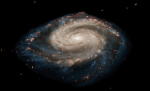 Virtual Flyby of the Whirlpool Galaxy
5.05.2019
What would it look like to fly over a spiral galaxy? To help visualize this, astronomers and animators at the Space Telescope Science Institute computed a virtual flyby of the Whirlpool Galaxy (M51) using data and images from the Hubble Space Telescope.
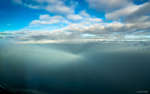 Anticrepuscular Rays Converge Opposite the Sun
23.06.2019
Is there ever anything interesting to see in the direction opposite the Sun? Sometimes there is. Notable items include your own shadow, a shadow of the Moon during a total solar eclipse, a full...
 APOD: 2024 January 31 Б Camera Orion Rising
30.01.2024
What does Orion rising look like to a camera? During this time of the year, the famous constellation is visible to the southeast just after sunset. From most Earthly locations, Orion's familiar star pattern, highlighted by the three-stars-in-a-row belt stars, rises sideways.
 APOD: 2024 November 12 Б NGC 6888: The Crescent Nebula
11.11.2024
How was the Crescent Nebula created? Looking like an emerging space cocoon, the Crescent Nebula, visible in the center of the featured image, was created by the brightest star in its center. A leading progenitor hypothesis has the Crescent Nebula beginning to form about 250,000 years ago.
 APOD: 2025 June 17 Б Rosette Nebula Deep Field
16.06.2025
Can you find the Rosette Nebula? The red flowery-looking nebula just above the image center may seem a good choice, but that's not it. The famous Rosette Nebula is really located on the lower right, here colored blue and white, and connected to the other nebulas by gold-colored filaments.
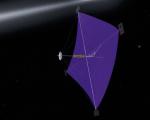 Solar Sail
26.05.2000
Nearly 400 years ago astronomer Johannes Kepler observed comet tails blown by a solar breeze and suggested that vessels might likewise navigate through space using appropriately fashioned sails. It is now widely recognized that...
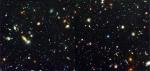 The Deep Field
8.02.1997
Galaxies like colorful pieces of candy fill the Hubble Deep Field - humanity's most distant yet optical view of the Universe. The dimmest, some as faint as 30th magnitude (about four billion times fainter...
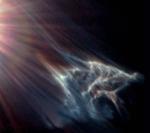 Reflecting Merope
3.12.2004
In the well known Pleiades star cluster, a star's light is slowly destroying this wandering cloud of gas and dust. Above, the star Merope lies just off the upper left edge of this picture from the Hubble Space Telescope.
|
January February March April May June July August |
||||||||||||||||||||||||||||||||||||||||||||||||||||||||