
|
You entered: spacecraft
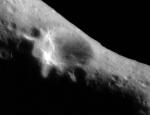 Eros From Orbit
16.02.2000
On February 14th, the NEAR spacecraft became the first artificial moon of an asteroid. Captured by the gentle gravity of a 20 mile long slipper-shaped mountain of rock, NEAR recorded this premier image while orbiting asteroid 433 Eros at a distance of about 200 miles.
 APOD: 2024 December 8 Б Aurora around Saturns North Pole
8.12.2024
Are Saturn's auroras like Earth's? To help answer this question, the Hubble Space Telescope and the Cassini spacecraft monitored Saturn's North Pole simultaneously during Cassini's final orbits around the gas giant in September 2017. During this time, Saturn's tilt caused its North Pole to be clearly visible from Earth.
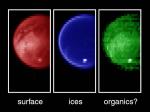 Titan from Cassini in Infrared
6.07.2004
Could life exist under the smog of Titan? If not, what is creating all of the methane? To help answer these questions, the largest and most mysterious moon of Saturn got a quick first look from the Cassini robot spacecraft soon after entering orbit around the giant planet last week.
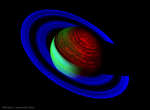 Neon Saturn
13.03.2016
If seen in the right light, Saturn glows like a neon sign. Although Saturn has comparatively little of the element neon, a composite image false-colored in three bands of infrared light highlights features of the giant ringed planet like a glowing sign.
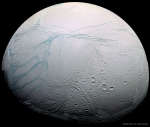 Fresh Tiger Stripes on Saturns Enceladus
27.04.2020
How will humanity first learn of extraterrestrial life? One possibility is to find it under the icy surface of Saturn's moon Enceladus. A reason to think that life may exist there are long features -- dubbed tiger stripes -- that are known to be spewing ice from the moon's icy interior into space.
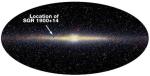 Magnetar In The Sky
2.10.1998
Indicated on this infrared image of the galactic center region is the position of SGR 1900+14 - the strongest known magnet in the galaxy. SGR 1900+14 is believed to be a city-sized, spinning, super-magnetic neutron star, or Magnetar. How strong is a Magnetar's magnetic field?
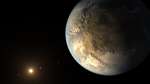 Earth size Kepler 186f
19.04.2014
Planet Kepler-186f is the first known Earth-size planet to lie within the habitable zone of a star beyond the Sun. Discovered using data from the prolific planet-hunting Kepler spacecraft, the distant world orbits...
 Flying Over Plutos Moon Charon
22.02.2016
Given some poetic license, there is now scientific evidence that hell has frozen over. To start, Greek mythology holds that Charon is the ferryman of the underworld. Next, recent analysis of data taken...
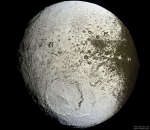 Saturns Iapetus: Painted Moon in 3D
13.07.2021
What has happened to Saturn's moon Iapetus? Vast sections of this strange world are dark brown, while others are as bright white. The composition of the dark material is unknown, but infrared spectra indicate that it possibly contains some dark form of carbon.
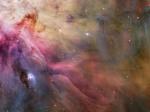 LL Ori and the Orion Nebula
20.01.2006
This esthetic close-up of cosmic clouds and stellar winds features LL Orionis, interacting with the Orion Nebula flow. Adrift in Orion's stellar nursery and still in its formative years, variable star LL Orionis produces a wind more energetic than the wind from our own middle-aged Sun.
|
January February March April May June July August September October |
|||||||||||||||||||||||||||||||||||||||||||||||||