
|
You entered: Earth
 APOD: 2024 January 8 Б The Phases of Venus
8.01.2024
Venus goes through phases. Just like our Moon, Venus can appear as a full circular disk, a thin crescent, or anything in between. Venus, frequently the brightest object in the post-sunset or pre-sunrise sky, appears so small, however, that it usually requires binoculars or a small telescope to clearly see its current phase.
 APOD: 2024 June 17 Б Ou4: The Giant Squid Nebula
17.06.2024
Squids on Earth aren't this big. This mysterious squid-like cosmic cloud spans nearly three full moons on planet Earth's sky. Discovered in 2011 by French astro-imager Nicolas Outters, the Squid Nebula's bipolar shape is distinguished here by the telltale blue emission from doubly ionized oxygen atoms.
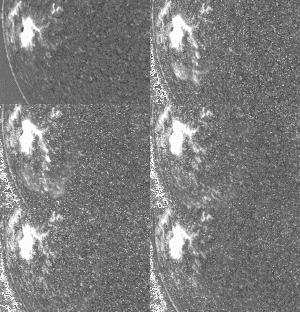 A Large Tsunami Shock Wave on the Sun
13.12.2006
Tsunami's this large don't happen on Earth. One week ago, a large solar flare from an Earth-sized sunspot produced a tsunami-type shock wave that was spectacular even for the Sun. Pictured above...
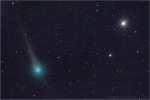 Lulin and Saturn near Opposition
27.02.2009
Tracking through the constellation Leo on February 23rd, bright planet Saturn and Comet Lulin were both near opposition -- opposite the Sun in planet Earth's sky. They also passed within only 2 degrees of each other creating a dramatic celestial photo-op.
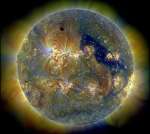 Venus and the Triply Ultraviolet Sun
20.08.2013
An unusual type of solar eclipse occurred last year. Usually it is the Earth's Moon that eclipses the Sun. Last June, most unusually, the planet Venus took a turn. Like a solar eclipse by the Moon, the phase of Venus became a continually thinner crescent as Venus became increasingly better aligned with the Sun.
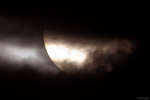 Mercurys Transit: An Unusual Spot on the Sun
8.05.2016
What's that dot on the Sun? If you look closely, it is almost perfectly round. The dot is the result of an unusual type of solar eclipse that occurred in 2006. Usually it is the Earth's Moon that eclipses the Sun. This time, the planet Mercury took a turn.
 Asteroid 2014 JO25
20.04.2017
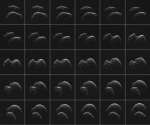
A day before its closest approach, asteroid 2014 JO25 was imaged by radar with the 70-meter antenna of NASA's Goldstone Deep Space Communications Complex in California. This grid of 30 radar images, top left to lower right, reveals the two-lobed shape of the asteroid that rotates about once every five hours.
 Milky Way and Exploding Meteor
6.08.2017
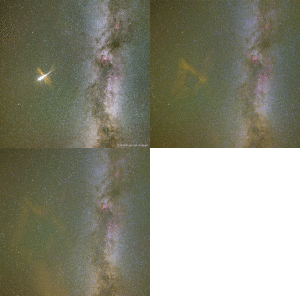
Next weekend the Perseid Meteor Shower reaches its maximum. Grains of icy rock will streak across the sky as they evaporate during entry into Earth's atmosphere. These grains were shed from Comet Swift-Tuttle.
 A February without Sunpots
6.03.2019
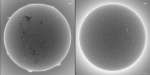
Where have all the sunspots gone? Last month the total number of spots that crossed our Sun was ... zero. Well below of the long term monthly average, the Sun's surface has become as unusually passive this solar minimum just like it did 11 years ago during the last solar minimum.
 APOD: 2024 April 29 Б Comet, Planet, Moon
29.04.2024
Three bright objects satisfied seasoned stargazers of the western sky just after sunset earlier this month. The most familiar was the Moon, seen on the upper left in a crescent phase. The rest of the Moon was faintly visible by sunlight first reflected by the Earth.
|
January February March April May June July August September October |
|||||||||||||||||||||||||||||||||||||||||||||||||