
|
You entered: Earth orbit
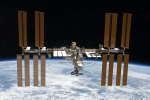 The International Space Station Expands Again
9.03.2011
The developing International Space Station (ISS) has changed its appearance again. In a recently completed rendezvous, the Space Shuttle orbiter Discovery, in its final flight, visited the ISS and added components that included the Leonardo Multi Purpose Logistics Module.
 A Solar Prominence Eruption from SDO
26.05.2019
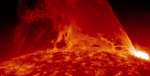
One of the most spectacular solar sights is an erupting prominence. In 2011, NASA's Sun-orbiting Solar Dynamic Observatory spacecraft imaged an impressively large prominence erupting from the surface. The dramatic explosion was captured in ultraviolet light in the featured time lapse video covering 90 minutes, where a new frame was taken every 24 seconds.
 A Solar Prominence Eruption from SDO
6.03.2016
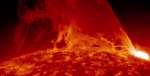
One of the most spectacular solar sights is an erupting prominence. In 2011, NASA's Sun-orbiting Solar Dynamic Observatory spacecraft imaged an impressively large prominence erupting from the surface. The dramatic explosion was captured in ultraviolet light in the above time lapse video covering 90 minutes, where a new frame was taken every 24 seconds.
 A Solar Prominence Eruption from SDO
7.03.2011
One of the most spectacular solar sights is an erupting prominence. Two weeks ago, NASA's Sun-orbiting Solar Dynamic Observatory spacecraft imaged an impressively large prominence erupting from the surface. The dramatic explosion...
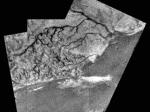 Riverbeds and Lakebeds Discovered on Saturn's Titan
24.01.2005
Methane rain, evaporating lakes, flowing rivers, and water ice-volcanoes all likely exist on Saturn's moon Titan, according to preliminary analyses of recent images taken by the successful Huygen's lander. A snaking...
 APOD: 2024 August 18 Б A Solar Prominence Eruption from SDO
18.08.2024
One of the most spectacular solar sights is an erupting prominence. In 2011, NASA's Sun-orbiting Solar Dynamic Observatory spacecraft imaged an impressively large prominence erupting from the surface. The dramatic explosion was captured in ultraviolet light in the featured time lapse video covering 90 minutes, where a new frame was taken every 24 seconds.
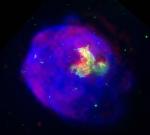 Structure in N63A
1.01.2004
Shells and arcs abound in this false-color, multiwavelength view of supernova remnant N63A, the debris of a massive stellar explosion. The x-ray emission (blue), is from gas heated to 10 million degrees C as knots of fast moving material from the cosmic blast sweep up surrounding interstellar matter.
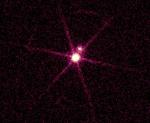 X-Rays From Sirius B
6.10.2000
In visible light Sirius A (Alpha Canis Majoris) is the brightest star in the night sky, a closely watched celestial beacon throughout recorded history. Part of a binary star system only 8 light-years away, it was known in modern times to have a small companion star, Sirius B.
 Jupiter and the Geminid
28.12.2023
For a brief moment, this brilliant fireball meteor outshone Jupiter in planet Earth's night. The serendipitous image was captured while hunting meteors under cold Canadian skies with a camera in timelapse mode on December 14, near the peak of the Geminid meteor shower.
 Moon O Clock 2022
6.01.2023
The first Full Moon of 2023 is in the sky tonight opposite the Sun at 23:08 UTC. Big and beautiful, the Moon at its brightest phase should be easy to spot. Still...
|
January February March April May June July August September October |
|||||||||||||||||||||||||||||||||||||||||||||||||