
|
You entered: Milky Way
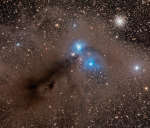 Stars and Dust Across Corona Australis
27.09.2012
Cosmic dust clouds sprawl across a rich field of stars in this sweeping telescopic vista near the northern boundary of Corona Australis, the Southern Crown. Probably less than 500 light-years away and effectively blocking...
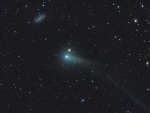 Comet PanSTARRS with Galaxy
6.06.2014
Sweeping slowly through northern skies, the comet PanSTARRS C/2012 K1 posed for this telescopic portrait on June 2nd in the constellation Ursa Major. Now in the inner solar system, the icy body from the Oort cloud sports two tails, a lighter broad dust tail and crooked ion tail extending below and right.
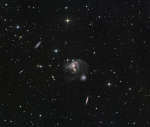 Hickson 91 in Piscis Austrinus
24.03.2016
Scanning the skies for galaxies, Canadian astronomer Paul Hickson and colleagues identified some 100 compact groups of galaxies, now appropriately called Hickson Compact Groups (HCGs). This sharp telescopic image captures one such galaxy group, HCG 91, in beautiful detail.
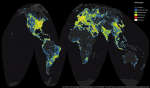 The New World Atlas of Artificial Sky Brightness
30.06.2016
How far are you from a naturally dark night sky? In increasing steps, this world map (medium | large) shows the effect of artificial night sky brightness on the visual appearance of the night sky. The brightness was modeled using high resolution satellite data and fit to thousands of night sky brightness measurements in recent work.
 APOD: 2025 March 10 Б NGC 1499: The California Nebula
10.03.2025
Could Queen Calafia's mythical island exist in space? Perhaps not, but by chance the outline of this molecular space cloud echoes the outline of the state of California, USA. Our Sun has its home within the Milky Way's Orion Arm, only about 1,000 light-years from the California Nebula.
 APOD: 2025 July 3 Б Nova V462 Lupi Now Visible
3.07.2025
If you know where to look, you can see a thermonuclear explosion from a white dwarf star. Possibly two. Such explosions are known as novas and the detonations are currently faintly visible with the unaided eye in Earth's southern hemisphere -- but are more easily seen with binoculars.
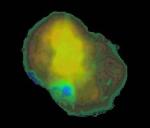 X-Rays From IC 443
2.05.1997
The life-cycles of stars help drive the ecology of our Galaxy, churning, processing, and redistributing matter. Massive stars reach a spectacular evolutionary endpoint - supernovae explosions which blast off their outer layers, violently merging stellar material with the gas and dust of the Milky Way. The supernova remnant IC 443 is typical of the aftermath.
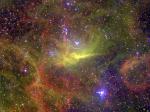 Nebulas Surrounding Wolf Rayet Binary
BAT99 49
Nebulas Surrounding Wolf Rayet Binary
BAT99 49
21.04.2004
How could two young stars power these colorful interstellar gas clouds? Although hidden by thick dust, the stars spew forceful ions and energetic radiation that cause the clouds to fragment and light up.
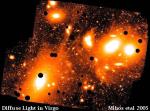 Streams of Stars in the Virgo Cluster of Galaxies
26.09.2005
How do huge clusters of galaxies evolve? To help find out, astronomers pointed the wide-angle Burrell-Schmidt telescope on Kitt Peak National Observatory in Arizona, USA at the nearby Virgo Cluster of Galaxies. After hundreds...
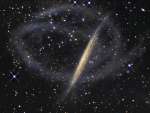 The Star Streams of NGC 5907
19.06.2008
Grand tidal streams of stars seem to surround galaxy NGC 5907. The arcing structures form tenuous loops extending more than 150,000 light-years from the narrow, edge-on spiral, also known as the Splinter or Knife Edge Galaxy.
|
January February March April May June July August September October |
|||||||||||||||||||||||||||||||||||||||||||||||||