
|
You entered: galaxies
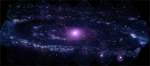 Ultraviolet Andromeda
17.09.2009
Taken by a telescope onboard NASA's Swift satellite, this stunning vista represents the highest resolution image ever made of the Andromeda Galaxy (aka M31) - at ultraviolet wavelengths. The mosaic is composed of 330 individual images covering a region 200,000 light-years wide.
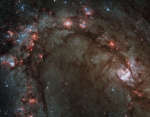 M83s Center from Refurbished Hubble
16.11.2009
What's happening at the center of spiral galaxy M83? Just about everything, from the looks of it. M83 is one of the closest spiral galaxies to our own Milky Way Galaxy and from a distance of 15 million light-years, appears to be relatively normal.
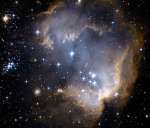 NGC 602 and Beyond
3.04.2010
Near the outskirts of the Small Magellanic Cloud, a satellite galaxy some 200 thousand light-years distant, lies 5 million year young star cluster NGC 602. Surrounded by natal gas and dust, NGC 602 is featured in this stunning Hubble image of the region.
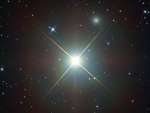 Mirach s Ghost
28.10.2010
As far as ghosts go, Mirach's Ghost isn't really that scary. In fact, Mirach's Ghost is just a faint, fuzzy galaxy, well known to astronomers, that happens to be seen nearly along the line-of-sight to Mirach, a bright star. Centered in this star field, Mirach is also called Beta Andromedae.
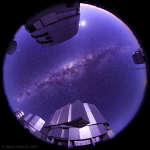 A Milky Way Dawn
29.03.2014
As dawn broke on March 27, the center of the Milky Way Galaxy stood almost directly above the European Southern Observatory's Paranal Observatory. In the dry, clear sky of Chile's Atacama desert...
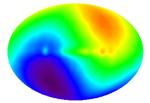 CMBR Dipole: Speeding Through the Universe
8.10.2006
Our Earth is not at rest. The Earth moves around the Sun. The Sun orbits the center of the Milky Way Galaxy. The Milky Way Galaxy orbits in the Local Group of Galaxies. The Local Group falls toward the Virgo Cluster of Galaxies.
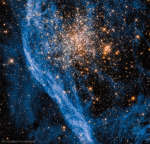 APOD: 2023 February 20 Б NGC 1850: Not Found in the Milky Way
20.02.2023
There is nothing like this ball of stars in our Milky Way Galaxy. This is surprising because, at first glance, this featured image by the Hubble Space Telescope suggests that star cluster NGC 1850...
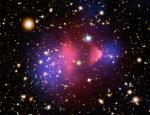 The Matter of the Bullet Cluster
24.08.2006
The matter in galaxy cluster 1E 0657-56, fondly known as the "bullet cluster", is shown in this composite image. A mere 3.4 billion light-years away, the bullet cluster's individual galaxies are seen...
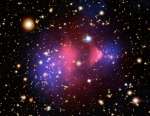 The Matter of the Bullet Cluster
23.08.2008
The matter in galaxy cluster 1E 0657-56, fondly known as the "bullet cluster", is shown in this composite image. A mere 3.4 billion light-years away, the bullet cluster's individual galaxies are seen...
 Ringed Nebulae
9.07.2004
Have you heard a lot about ringed planets lately? Well, consider this gorgeous celestial vista centered on the Milky Way's own planetary nebula M57, the famous Ring Nebula. The wide view...
|
January February March April May June July August September October |
|||||||||||||||||||||||||||||||||||||||||||||||||