
|
You entered: Earth orbit
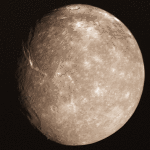 Uranus' Largest Moon: Titania
4.03.1996
Titania's tortured terrain is a mix of valleys and craters. NASA's interplanetary robot spacecraft Voyager 2 passed this moon of Uranus in 1986 and took the above photograph. The photograph was then transmitted back to earth by radio.
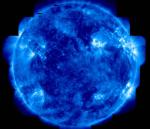 Autumn and the Active Sun
23.09.1998
As the Sun heads South, crossing the celestial equator today at 1:37 a.m. Eastern Time, Autumn begins for Earth's Northern Hemisphere. This Autumnal Equinox finds an increasingly active Sun steadily approaching a solar cycle maximum expected around the year 2003.
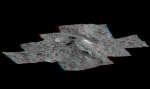 3D Ahuna Mons
19.03.2016
Get out your red/blue glasses and gaze across Ceres at mysterious mountain Ahuna Mons. Shown in a 3D anaglyph perspective view, the mosaicked image data was captured in December of 2015, taken from the Dawn spacecraft's low-altitude mapping orbit about 385 kilometers above the surface of the dwarf planet.
 APOD: 2025 September 26 Б A SWAN an ATLAS and Mars
26.09.2025
A new visitor to the inner Solar System, comet C/2025 R2 (SWAN) sports a long ion tail extending diagonally across this almost 7 degree wide telescopic field of view recorded on September 21.
 APOD: 2024 April 17 Б Total Eclipse and Comets
17.04.2024
Not one, but two comets appeared near the Sun during last week's total solar eclipse. The expected comet was Comet 12P/Pons-Brooks, but it was disappointingly dimmer than many had hoped. However, relatively unknown Comet SOHO-5008 also appeared in long duration camera exposures.
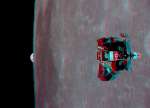 The Eagle Rises
25.07.2009
Get out your red/blue glasses and check out this remarkable stereo view from lunar orbit. Created from two photographs (AS11-44-6633, AS11-44-6634) taken by astronaut Michael Collins forty years ago during the 1969 Apollo...
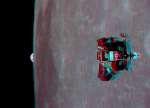 The Eagle Rises
10.08.2008
Get out your red/blue glasses and check out this remarkable stereo view from lunar orbit. Created from two photographs (AS11-44-6633, AS11-44-6634) taken by astronaut Michael Collins during the 1969 Apollo 11 mission, the 3D anaglyph features the lunar module ascent stage, dubbed The Eagle, as it rises to meet the command module in lunar orbit.
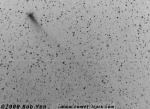 Comet LINEAR Extends
10.07.2000
Comet LINEAR's tail appears to be extending. Many sky watchers are closely following Comet C/1999 S4 LINEAR and wondering if it will develop an impressive tail or become visible to the naked eye later this month.
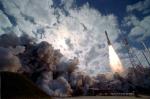 New Horizons Launches to Pluto
24.01.2006
Destination: Pluto. The New Horizons spacecraft roared off its launch pad at Cape Canaveral in Florida, USA last week toward adventures in the distant Solar System. The craft is one of the fastest spaceships...
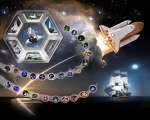 Space Shuttle Tribute Poster: Endeavour
7.09.2010
They are some of the most complex machines ever built. From a standing start they can launch a school- bus sized object up so high and moving so fast that it won't fall back down.
|
January February March April May June July August September October |
|||||||||||||||||||||||||||||||||||||||||||||||||