
|
You entered: dark
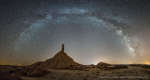 Milky Way Over Spains Bardenas Reales
2.09.2013
What's that below the Milky Way? First, across the top of the above image, lies the faint band that is our planet's sideways view of the central disk of our home Milky Way Galaxy.
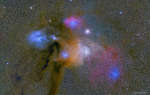 Colorful Clouds Near Rho Ophiuchi
5.07.2015
Why is the sky near Antares and Rho Ophiuchi so colorful? The colors result from a mixture of objects and processes. Fine dust illuminated from the front by starlight produces blue reflection nebulae. Gaseous clouds whose atoms are excited by ultraviolet starlight produce reddish emission nebulae. Backlit dust clouds block starlight and so appear dark.
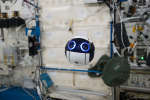 Int Ball Drone Activated on the Space Station
24.07.2017
What if you were followed around by a cute floating ball that kept taking your picture? Then you might be an astronaut on today's International Space Station (ISS). Designed by the Japan Aerospace...
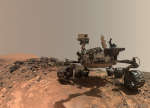 Curiosity Rover Takes Selfie on Mars
19.11.2017
Yes, but have you ever taken a selfie on Mars? The Curiosity rover on Mars has. This selfie was compiled from many smaller images -- which is why the mechanical arm holding the camera is not visible.
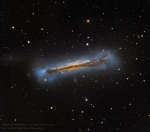 NGC 3682: Sideways Spiral Galaxy
4.09.2018
What do spiral galaxies look like sideways? Featured is a sharp telescopic view of a magnificent edge-on spiral galaxy NGC 3628, a puffy galactic disk divided by dark dust lanes. Of course, this deep galactic portrait puts some astronomers in mind of its popular moniker, The Hamburger Galaxy.
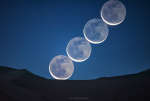 Da Vinci Rise
25.09.2019
An old Moon rose this morning, its waning sunlit crescent shining just above the eastern horizon before sunrise. But earthshine, light reflected from a bright planet Earth, lit the shadowed portion of the lunar disk and revealed most of a familiar lunar near side to early morning risers.
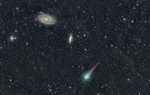 Comet PanSTARRs and the Galaxies
5.06.2020
Comet PanSTARRs, C/2017 T2, shared this stunning telescopic field of view with galaxies M81 and M82 on May 22/23. Of course, the galaxies were some 12 million light-years distant and the comet about 14 light-minutes away, seen in planet Earth's sky toward the Big Dipper.
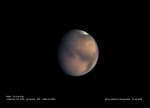 The Red Planet Mars
29.07.2020
Mars looks pretty sharp in this backyard telescope image captured on July 23 from Hoegaarden, Belgium, planet Earth. The Red Planet's bright south polar cap is bathed in sunlight at the top of the inverted view, while the dark feature known as Syrtis Major extends toward the right (eastern) edge.
 A Little Like Mars
4.03.2021
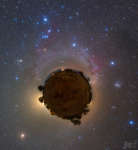
The surface of this planet looks a little like Mars. It's really planet Earth though. In a digitally stitched little planet projection, the 360 degree mosaic was captured near San Pedro in the Chilean Atacama desert. Telescopes in domes on the horizon are taking advantage of the region's famously dark, clear nights.
 IC 4592: The Blue Horsehead Reflection Nebula
4.07.2021
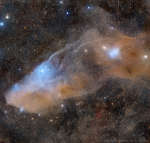
Do you see the horse's head? What you are seeing is not the famous Horsehead nebula toward Orion but rather a fainter nebula that only takes on a familiar form with deeper imaging. The main part of the here imaged molecular cloud complex is a reflection nebula cataloged as IC 4592.
|
January February March April May June July August September |
|||||||||||||||||||||||||||||||||||||||||||||||||