
|
You entered: Earth's moon
 APOD: 2026 August 18 Б Perseids from Perseus
18.08.2026
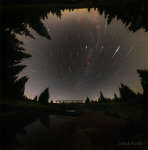
This was a good year for the Perseids meteor shower. A key reason was the Moon was absent from lighting up Earth's night sky so that more meteors were visible than usual. Where was the Moon? It was busy visiting the Sun.
 Ice Halos by Moonlight
14.05.2022
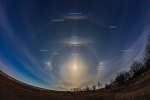
An almost full moon on April 15 brought these luminous apparitions to a northern spring night over Alberta Canada. On that night, bright moonlight refracted and reflected by hexagonal ice crystals in high clouds created a complex of halos and arcs more commonly seen by sunlight in daytime skies.
 APOD: 2023 September 17 Б Moon Mountains Magnified during Ring of Fire Eclipse
17.09.2023
What are those dark streaks in this composite image of a solar eclipse? They are reversed shadows of mountains at the edge of the Moon. The center image, captured from Xiamen, China, has the Moon's center directly in front of the Sun's center.
 Moons and Bright Mars
1.08.2003
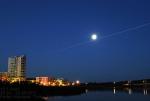
In this serene view, the moons of Earth along with the bright planet Mars shine above the city of Turku near the southwestern tip of Finland. Of course Earth's large natural satellite, the Moon, at a distance of 400,000 kilometers, is by far the brightest object in this sky.
 Eye of Moon
2.12.2020
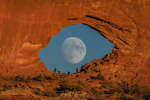
Who's watching who? The featured image of the Moon through a gap in a wall of rock may appear like a giant eye looking back at you. Although, in late October, it took only a single exposure to capture this visual double, it also took a lot of planning.
 Red Planet Red Moon and Mars
9.08.2018
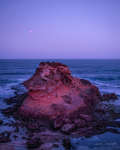
Mars is also known as The Red Planet, often seen with a reddish tinge in dark night skies. Mars shines brightly at the upper left of this gorgeous morning twilight view from Mornington Peninsula, Victoria, Australia, but the Moon and planet Earth look redder still. Taken on July 27, the totally eclipsed Moon is setting.
 ISS: Sunlight to Shadow
28.02.2008
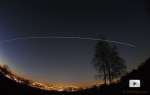
Orbiting 400,000 kilometers above the Earth, the Moon slid into Earth's shadow to begin last week's total lunar eclipse. Of course the International Space Station (ISS) slides into Earth's shadow every 90 minutes, the time it takes it to complete one orbit at an altitude of about 400 kilometers.
 APOD: 2025 September 11 Б The Umbra of Earth
11.09.2025
The dark, inner shadow of planet Earth is called the umbra. Shaped like a cone extending into space, it has a circular cross section most easily seen during a lunar eclipse.
 Caterpillar Moon
24.05.2013
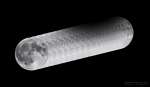
A close series of consecutive exposures are combined in this intriguing composite of the Full Moon slowly crawling, across the sky. Beginning on the upper right at 19:42 UT and ending...
 August Lunar Eclipse
9.08.2017
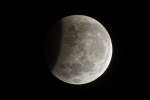
August's Full Moon is framed in this sharp, high dynamic range composition. Captured before sunrise on August 8 from Sydney, Australia, south is up and the Earth's dark, umbral shadow is at the left, near the maximum phase of a partial lunar eclipse.
|
January February March April May June July August September |
|||||||||||||||||||||||||||||||||||||||||||||||||