
|
You entered: Moon
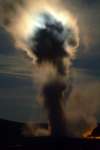 Old Faithful Moon
3.10.2009
Scheduled to illuminate the landscape throughout the night tomorrow, October's bright Full Moon will also be called the Harvest Moon. Traditionally, the Harvest Moon is the Full Moon closest to the autumnal equinox. But in this vacation snapshot, the Full Moon could be called the "Old Faith-Full Moon".
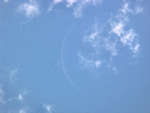 Crescent Venus and Moon
16.05.2010
There's something behind these clouds. Those faint graceful arcs, upon inspection, are actually far, far in the distance. They are the Earth's Moon and the planet Venus. Both the Moon and Venus are bright enough to be seen during the day, and both are quite capable of showing a crescent phase.
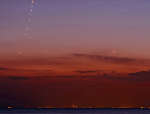 Venus, Mercury, and Moon
22.04.2010
Earlier this month, Venus and Mercury climbed into the western twilight, entertaining skygazers around planet Earth in a lovely conjunction of evening stars. Combining 8 images spanning April 4 through April 15, this composite tracks their progress through skies above Portsmouth, UK. Each individual image was captured at 19:50 UT.
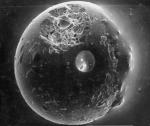 A Spherule from the Earths Moon
20.05.2007
How did this spherule come to be on the Moon? When a meteorite strikes the Moon, the energy of the impact melts some of the splattering rock, a fraction of which might cool into tiny glass beads. Many of these glass beads were present in lunar soil samples returned to Earth by the Apollo missions.
 Bow Tie Moon and Star Trails
8.02.2018
On January 31, a leisurely lunar eclipse was enjoyed from all over the night side of planet Earth, the first of three consecutive total eclipses of the Moon. This dramatic time-lapse image followed the celestial performance for over three hours in a combined series of exposures from Hebei Province in Northern China.
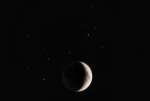 Young Moon and Sister Stars
26.03.2010
A young crescent Moon shares the western sky with sister stars of the Pleiades cluster in this pretty, evening skyscape recorded on the March equinox from San Antonio, Texas. In the processed digital image, multiple exposures of the celestial scene were combined to show details of the bright lunar surface along with the Pleiades stars.
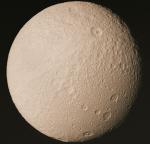 Saturns Moon Tethys
19.05.2002
Tethys is one of the larger and closer moons of Saturn. It was visited by both Voyager spacecraft - Voyager 1 in November 1980 and by Voyager 2 in August 1981. Tethys is now known to be composed almost completely of water ice. Tethys shows a large impact crater that nearly circles the planet.
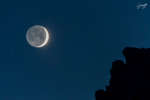 The Bull s Eye and the Young Moon
5.05.2017
Aldebaran, eye of Taurus the Bull, and a young crescent Moon shared an early evening sky last Friday. The lovely celestial pairing could be enjoyed around planet Earth, but from some locations the Moon was even seen to pass in front of Aldebaran, a dramatic lunar occultation of the familiar bright star.
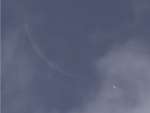 Moon and Morning Star
24.04.2009
Wednesday, the Moon and Venus rose together in early morning skies. Even through clouds, both show off a lovely crescent in this well-composed skyscape from Rutherford College, North Carolina, in the eastern US. Farther west, North American skygazers could also witness the Moon passing in front of Venus.
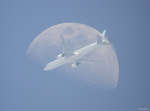 An Airplane in Front of the Moon
3.07.2018
If you look closely at the Moon, you will see a large airplane in front of it. Well, not always. OK, hardly ever. Actually, to capture an image like this takes precise timing...
|
January February March April May June July August September October |
|||||||||||||||||||||||||||||||||||||||||||||||||