
|
You entered: Orion Nebula
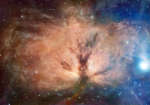 The Flame Nebula in Visible and Infrared
8.12.2014
What lights up the Flame Nebula? Fifteen hundred light years away towards the constellation of Orion lies a nebula which, from its glow and dark dust lanes, appears, on the left, like a billowing fire. But fire, the rapid acquisition of oxygen, is not what makes this Flame glow.
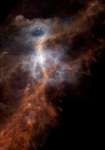 Herschel s Orion
14.10.2016
This dramatic image peers within M42, the Orion Nebula, the closest large star-forming region. Using data at infrared wavelengths from the Herschel Space Observatory, the false-color composite explores the natal cosmic cloud a mere 1,500 light-years distant.
 APOD: 2025 August 13 Б Trapezium: In the Heart of Orion
13.08.2025
What lies in the heart of Orion? Trapezium: four bright stars, that can be found near the center of this sharp cosmic portrait. Gathered within a region about 1.5 light-years in radius, these stars dominate the core of the dense Orion Nebula Star Cluster.
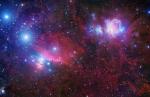 The Orion Deep Field
6.01.2007
Adrift 1,500 light-years away in one of the night sky's most recognizable constellations, the glowing Orion Nebula and the dark Horsehead Nebula are contrasting cosmic vistas. But even fainter filaments of glowing...
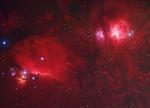 An Orion Deep Field
15.01.2004
Adrift 1,500 light-years away in one of the night sky's most recognizable constellations, the glowing Orion Nebula and the dark Horsehead Nebula are contrasting cosmic vistas. They both appear in this stunning composite digital image assembled from over 20 hours of data that includes exposures filtered to record emission from hydrogen atoms.
 The Lynx Arc
5.11.2003
While chasing the spectrum of a mysterious arc in a cluster of galaxies within the obscure northerly constellation Lynx, astronomers have stumbled upon the most massive and distant star-forming region ever discovered. The notably...
 An Orion Deep Field
15.10.2006
Adrift 1,500 light-years away in one of the night sky's most recognizable constellations, the glowing Orion Nebula and the dark Horsehead Nebula are contrasting cosmic vistas. They both appear in this stunning composite digital image assembled from over 20 hours of data that includes exposures filtered to record emission from hydrogen atoms.
 NGC 1999: South of Orion
30.01.2006
South of the large star-forming region known as the Orion Nebula, lies bright blue reflection nebula NGC 1999. The nebula is marked with a dark inverted T-shape at the lower left in a broad cosmic vista that spans over 10 light-years.
 LL Orionis: When Cosmic Winds Collide
13.03.2002
This arcing, graceful structure is actually a bow shock about half a light-year across, created as the wind from young star LL Orionis collides with the Orion Nebula flow. Adrift in Orion's stellar...
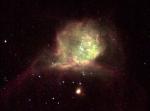 Star Forming Region Hubble X
16.02.2001
In nearby galaxy NGC 6822, this glowing emission nebula complex surrounds bright, massive, newborn stars. A mere 4 million years young, these stars condensed from the galaxy's interstellar gas and dust clouds.
|
January February March April May June July August September October |
|||||||||||||||||||||||||||||||||||||||||||||||||