
|
You entered: Saturn rings
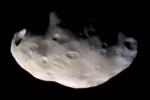 Pandora: A Shepherd Moon of Saturn
23.11.2005
What does Saturn's small moon Pandora look like? To help find out, the robot Cassini spacecraft now orbiting Saturn passed about 50,000 kilometers from the unusual moon in early September. The highest resolution image of Pandora ever taken was then captured and is shown above in representative colors.
 Saturn at Night
24.10.2025
Saturn is bright in Earth's night skies. Telescopic views of the outer gas giant planet and its beautiful rings often make it a star at star parties. But this stunning view of Saturn's rings and night side just isn't possible from telescopes in the vicinity of planet Earth.
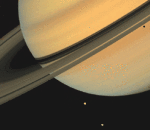 Saturn with Moons Tethys and Dione
31.05.1997
Saturn and two of its larger moons - Tethys and Dione - were photographed by the Voyager 1 spacecraft which flew by the planet in November of 1980. This picture gives an indication of Saturn's extensive ring system, which can be seen casting a shadow on the planet, as does Tethys.
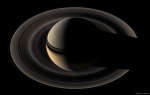 Crescent Saturn
7.07.2019
Saturn never shows a crescent phase -- from Earth. But when viewed from beyond, the majestic giant planet can show an unfamiliar diminutive sliver. This image of crescent Saturn in natural color was taken by the robotic Cassini spacecraft in 2007.
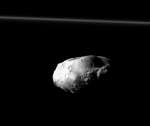 Prometheus and the F Ring
8.01.2016
In Greek myth Prometheus was a Titan, known for bringing fire from Mount Olympus. But in modern times the name is given to is a small moon of Saturn, orbiting just inside Saturn's F ring.
 Pandora Close up at Saturn
3.01.2017
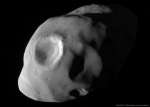
What do the craters of Saturn's small moon Pandora look like up close? To help find out, NASA sent the robotic Cassini spacecraft, now orbiting Saturn, past the unusual moon two weeks ago. The highest resolution image of Pandora ever taken was then captured from about 40,000 kilometers out and is featured here.
 APOD: 2024 December 8 Б Aurora around Saturns North Pole
8.12.2024
Are Saturn's auroras like Earth's? To help answer this question, the Hubble Space Telescope and the Cassini spacecraft monitored Saturn's North Pole simultaneously during Cassini's final orbits around the gas giant in September 2017. During this time, Saturn's tilt caused its North Pole to be clearly visible from Earth.
 Saturn with Moons Tethys and Dione
18.03.1996
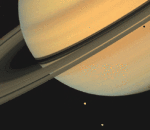
Saturn and two of its larger moons - Tethys and Dione - were photographed by the Voyager 1 spacecraft which flew by the planet in November of 1980. This picture gives an indication of Saturn's extensive ring system, which can be seen casting a shadow on the planet, as does Tethys.
 Aurora around Saturns North Pole
3.09.2018
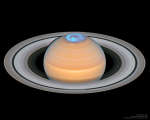
Are Saturn's auroras like Earth's? To help answer this question, the Hubble Space Telescope and the Cassini spacecraft monitored Saturn's North Pole simultaneously during Cassini's final orbits around the gas giant in September 2017. During this time, Saturn's tilt caused its North Pole to be clearly visible from Earth.
 Saturn in Color
12.03.1997
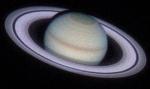
Saturn is unusual but photogenic. The second largest planet in our Solar System, behind Jupiter, has been easily identifiable at night since history has been recorded. It was only with the invention of the telescope, however, that any evidence of its majestic ring system became apparent.
|
January February March April May June July August September October |
|||||||||||||||||||||||||||||||||||||||||||||||||