
|
You entered: active region
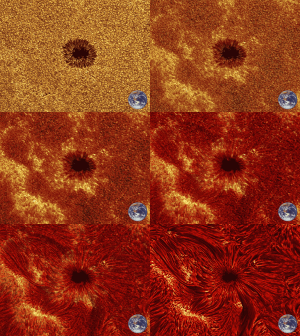 Sunspot Metamorphosis: From Bottom to Top
15.02.2005
Sunspots -- magnets the size of the Earth -- are normally seen flat on the Sun. The above digital metamorphosis, however, shows a sunspot as it appears at increasing heights, effectively in three dimensions. The above...
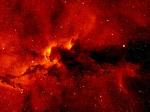 IC 1396 Close Up
30.09.2005
Clouds of glowing hydrogen gas mingle ominously with dark dust lanes in this close-up of IC 1396, an active star forming region some 2,000 light years away in the constellation Cepheus. In this and other similar emission nebulae, energetic ultraviolet light from a hot young star strips electrons from the surrounding hydrogen atoms.
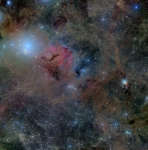 Stardust in Perseus
11.01.2023
This cosmic expanse of dust, gas, and stars covers some 6 degrees on the sky in the heroic constellation Perseus. At upper left in the gorgeous skyscape is the intriguing young star cluster IC 348 and neighboring Flying Ghost Nebula with clouds of obscuring interstellar dust cataloged as Barnard 3 and 4.
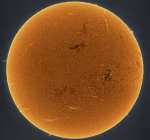 Orange Sun Scintillating
15.11.2011
Our Sun is becoming a busy place. Taken just last week, the Sun was captured sporting numerous interesting features including one of the larger sunspot groups yet recorded: AR 1339 visible on the image right. Only last year, the Sun was emerging from an unusually quiet Solar Minimum that lasted for years.
 Seventeen Hundred Kilometers Above Enceladus
4.11.2008
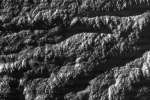
Above is one of the closest pictures yet obtained of Saturn's ice-spewing moon Enceladus. The image was taken from about 1,700 kilometers up as the robotic Cassini spacecraft zoomed by the fractured ice ball last week.
 Clouds of Perseus
21.10.2011
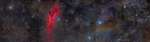
Cosmic clouds of gas and dust drift across this magnificent panorama, spanning some 17 degrees near the southern boundary of the heroic constellation Perseus. The collaborative skyscape begins with bluish stars of Perseus at the left, but the eye is drawn to the striking, red NGC 1499.
 The Sharpest View of the Sun
13.11.2002
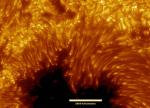
This stunning image shows remarkable and mysterious details near the dark central region of a planet-sized sunspot in one of the sharpest views ever of the surface of the Sun. Just released, the picture was made using the Swedish Solar Telescope now in its first year of operation on the Canary Island of La Palma.
 APOD: 2026 June 28 Б AR 4478: Giant Sunspot Group
27.06.2026
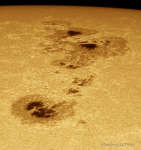
Right now, one of the largest sunspot groups in recent history is crossing the Sun. Active Region 4478 is not only big -- it's violent, showing tangled magnetic fields capable of throwing off huge clouds of particles into the Solar System. Some of these CMEs might impact the Earth.
 APOD: 2024 October 2 Б The Large Magellanic Cloud Galaxy
1.10.2024
It is the largest satellite galaxy of our home Milky Way Galaxy. If you live in the south, the Large Magellanic Cloud (LMC) is quite noticeable, spanning about 10 degrees across the night sky, which is 20 times larger than the full moon towards the southern constellation of the dolphinfish (Dorado).
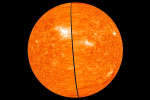 Sun 360: STEREO Captures Views of the Entire Sun
6.02.2011
For the first time, the entire Sun is being imaged all at once. This has become possible because the two STEREO satellites orbiting and monitoring the Sun are now on opposite sides of the Sun.
|
January February March April May June July August September |
|||||||||||||||||||||||||||||||||||||||||||||||||