
|
You entered: black hole
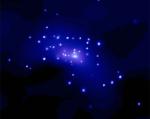 NGC 4697: X Rays from an Elliptical Galaxy
17.06.2002
The many bright, point-like sources in this Chandra Observatory x-ray image lie within NGC 4697, an elliptical galaxy some 40 million light-years away towards Virgo. Like other normal elliptical galaxies, NGC 4697 is a spherical ensemble of mainly older, fainter, low mass stars, with little star forming gas and dust compared to spiral galaxies.
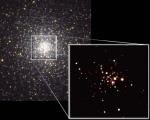 X Ray Stars of 47 Tucanae
24.05.2001
A deep optical image (left) of 47 Tucanae shows an ancient globular star cluster so dense and crowded that individual stars can not be distinguished in its closely packed core. An x-ray image of its central regions (inset right) from the Chandra Observatory reveals a wealth of x-ray stars hidden there.
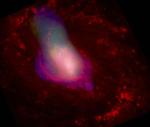 NGC 1068 and the X Ray Flashlight
11.07.2003
At night, tilting a flashlight up under your chin hides the glowing bulb from the direct view of your friends. Light from the bulb still reflects from your face though, and can give you a startling appearance.
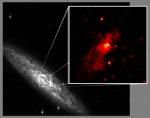 NGC 253: X Ray Zoom
7.06.2001
Astronomers now report that Chandra X-ray Observatory observations of galaxies known to be frantically forming stars show that these galaxies also contain luminous x-ray sources -- thought to be intermediate mass black holes and immense clouds of superheated gas. Take the lovely island universe NGC 253 for example.
 M87 s Energetic Jet
1.11.2001
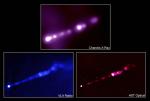
An energetic jet from the core of giant elliptical galaxy M87 stretches outward for 5,000 light-years. This monstrous jet appears in the panels above to be a knotted and irregular structure, dectected across the spectrum, from x-ray to optical to radio wavelengths.
 M87 s Energetic Jet
11.12.2004
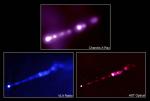
An energetic jet from the core of giant elliptical galaxy M87 stretches outward for 5,000 light-years. This monstrous jet appears in the panels above to be a knotted and irregular structure, detected across the spectrum, from x-ray to optical to radio wavelengths.
 The Case of the Missing Star
6.06.2017
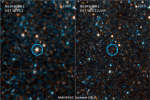
What's happened to giant star N6946-BH1? It was there just a few years ago -- Hubble imaged it. Now there's only a faint glow. What's curiouser, no bright supernova occurred -- although the star did brightened significantly for a few months.
 NGC 7331: A Galaxy So Inclined
1.07.2004
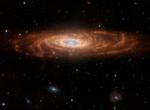
If our own Milky Way galaxy were 50 million light-years away with its disk inclined slightly to our line of sight, it would look a lot like large spiral galaxy NGC 7331. In fact...
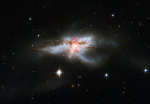 NGC 6240: Merging Galaxies
21.05.2015
NGC 6240 offers a rare, nearby glimpse of a cosmic catastrophe in its final throes. The titanic galaxy-galaxy collision takes place a mere 400 million light-years away in the constellation Ophiuchus. The merging galaxies spew distorted tidal tails of stars, gas, and dust and undergo fast and furious bursts of star formation.
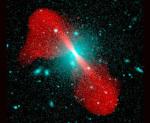 Jets from Radio Galaxy 3C296
26.02.2002
Jets of streaming plasma expelled by the central black hole of a massive elliptical galaxy likely light up this composite image of 3C296. The jets emanating from NGC 5532 and are nearly a million light years long. Exactly how the central black hole expels the infalling matter is still unknown.
|
January February March April May June July August September October |
|||||||||||||||||||||||||||||||||||||||||||||||||