
|
You entered: cluster gas
 Simulation TNG50: A Galaxy Cluster Forms
29.05.2022
How do clusters of galaxies form? Since our universe moves too slowly to watch, faster-moving computer simulations are created to help find out. A recent effort is TNG50 from IllustrisTNG, an upgrade of the famous Illustris Simulation.
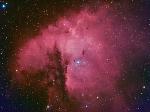 NGC 281: Cluster, Clouds, and Globules
20.10.2004
NGC 281 is a busy workshop of star formation. Prominent features include a small open cluster of stars, a diffuse red-glowing emission nebula, large lanes of obscuring gas and dust, and dense knots of dust and gas in which stars may still be forming.
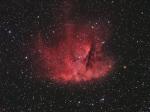 NGC 281: The Pacman Nebula
23.08.2005
NGC 281 is a busy workshop of star formation. Prominent features include a small open cluster of stars, a diffuse red-glowing emission nebula, large lanes of obscuring gas and dust, and dense knots of dust and gas in which stars may still be forming.
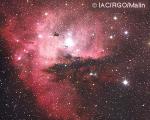 NGC 281: Cluster, Clouds, and Globules
21.09.1998
NGC 281 is a busy workshop of star formation. Prominent features include a small open cluster of stars, a diffuse red-glowing emission nebula, large lanes of obscuring gas and dust, and dense knots of dust and gas in which stars may still be forming.
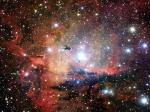 NGC 281: Cluster, Clouds, and Globules
7.04.2003
NGC 281 is a busy workshop of star formation. Prominent features include a small open cluster of stars, a diffuse red-glowing emission nebula, large lanes of obscuring gas and dust, and dense knots of dust and gas in which stars may still be forming.
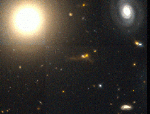 Elliptical Galaxy NGC 4881 in Coma
6.11.1996
Elliptical galaxies are unlike spiral galaxies and hence unlike our own Milky Way Galaxy. The giant elliptical galaxy named NGC 4881 on the upper left lies at the edge of the giant Coma Cluster of Galaxies.
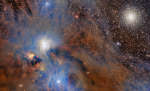 APOD: 2026 July 22 Б The Corona Australis Cloud and the Chandelier Cluster
22.07.2026
The Southern Crown (Corona Australis) dazzles with young and ancient celestial jewels. The Corona Australis Cloud is a collage of reflection and emission nebulae on the left of todayБs image. At 430 light years away, this cloud is one of the closest star-forming regions to Earth.
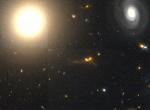 Elliptical Galaxy NGC 4881 in Coma
21.11.1999
Elliptical galaxies are unlike spiral galaxies and hence unlike our own Milky Way Galaxy. The giant elliptical galaxy named NGC 4881 on the upper left lies at the edge of the giant Coma Cluster of Galaxies.
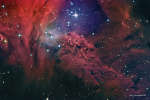 The Fox Fur Nebula
30.12.2015
This interstellar canine is formed of cosmic dust and gas interacting with the energetic light and winds from hot young stars. The shape, visual texture, and color, combine to give the region the popular name Fox Fur Nebula.
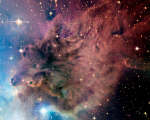 The Fox Fur Nebula from CFHT
22.04.2008
This interstellar beast is formed of cosmic dust and gas interacting with the energetic light and winds from hot young stars. The shape, visual texture, and color, combine to give the region the popular name Fox Fur Nebula.
|
January February March April May June July August September |
|||||||||||||||||||||||||||||||||||||||||||||||||