
|
You entered: distance
 The Farthest Explosion Yet Measured
19.10.2000
It happened so far away that common human distance measures are inadequate to describe it. Furthermore, astronomers do not even claim to know exactly what happened. What is known is that satellites across our Solar System reported on 2000 January 31 a tremendous explosion of gamma rays had occurred towards some previously uninteresting direction.
 Ring Scan
24.11.2016
Scroll right and you can cruise along the icy rings of Saturn. This high resolution scan is a mosaic of images presented in natural color. The images were recorded in May 2007 over about 2.5 hours as the Cassini spacecraft passed above the unlit side of the rings.
 Along the Western Veil
19.09.2019
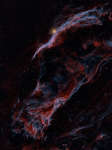
Delicate in appearance, these filaments of shocked, glowing gas, are draped across planet Earth's sky toward the constellation of Cygnus. They form the western part of the Veil Nebula. The Veil Nebula itself is a large supernova remnant, an expanding cloud born of the death explosion of a massive star.
 A Redshift Lookup Table for our Universe
8.04.2013
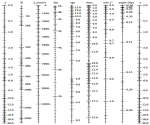
How far away is "redshift six"? Although humans are inherently familiar with distance and time, what is actually measured for astronomical objects is redshift, a color displacement that depends on exactly how energy density has evolved in our universe.
 Fomalhaut's Dusty Debris Disk
11.05.2023
Fomalhaut is a bright star, a 25 light-year voyage from planet Earth in the direction of the constellation Piscis Austrinus. Astronomers first noticed Fomalhaut's excess infrared emission in the 1980s. Space and ground-based...
 The Rise and Fall of Supernova 2015F
9.02.2016
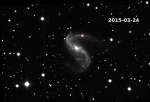
Sit back and watch a star explode. The actual supernova occurred back when dinosaurs roamed the Earth, but images of the spectacular event began arriving last year. Supernova 2015F was discovered in nearby spiral...
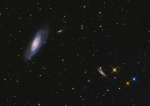 A View Toward M106
1.05.2020
Big, bright, beautiful spiral, Messier 106 dominates this cosmic vista. The nearly two degree wide telescopic field of view looks toward the well-trained constellation Canes Venatici, near the handle of the Big Dipper. Also...
 Stars and Dust across Corona Australis
22.06.2023
Cosmic dust clouds cross a rich field of stars in this telescopic vista near the northern boundary of Corona Australis, the Southern Crown. Part of a sprawling molecular cloud complex this star forming region is a mere 500 light-years away.
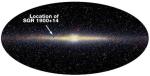 Magnetar In The Sky
2.10.1998
Indicated on this infrared image of the galactic center region is the position of SGR 1900+14 - the strongest known magnet in the galaxy. SGR 1900+14 is believed to be a city-sized, spinning, super-magnetic neutron star, or Magnetar. How strong is a Magnetar's magnetic field?
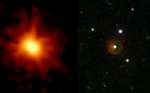 Across the Universe
28.03.2008
How far can you see? Even the faintest stars visible to the eye are merely hundreds or thousands of light-years distant, all well within our own Milky Way Galaxy. Of course, if you know where to look you can also spot the Andromeda Galaxy as a pale, fuzzy cloud, around 2.5 million light-years away.
|
January February March April May June July August September October |
|||||||||||||||||||||||||||||||||||||||||||||||||