
|
You entered: gamma ray
 A High Energy Fleet
25.11.2000
Like a fleet of futuristic starcruisers, NASA's highly successful series of High Energy Astrophysical Observatory (HEAO) spacecraft appear poised over planet Earth. Labeled A, B, and C in this vintage illustration, the spacebased telescopes were known as HEAO-1, HEAO-2, and HEAO-3 respectively.
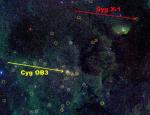 Cyg X-1: Can Black Holes Form in the Dark?
2.04.2005
The formation of a black hole from the collapsing core of a massive star is thought to be heralded by a spectacular supernova explosion. Such an extremely energetic collapse is also a leading explanation for the mysterious cosmic gamma-ray bursts.
 NGC 253: Close Up
19.05.2011
This dusty island universe is one of the brightest spiral galaxies in planet Earth's sky. Seen nearly edge-on, NGC 253 is only 13 million light-years away, the largest member of the Sculptor Group of galaxies, neighbor to our own local galaxy group.
 The Pulsar Powered Crab
2.06.2001
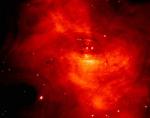
In the Summer of 1054 A.D. Chinese astronomers reported that a star in the constellation of Taurus suddenly became as bright as the full Moon. Fading slowly, it remained visible for over a year.
 NGC 253: The Silver Coin Galaxy
14.04.2020
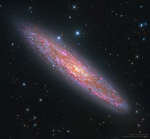
NGC 253 is one of the brightest spiral galaxies visible, but also one of the dustiest. Dubbed the Silver Coin for its appearance in smalltelescopes, it is more formally known as the Sculptor Galaxy for its location within the boundaries of the southern constellation Sculptor.
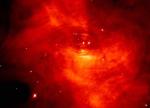 The Pulsar Powered Crab
5.09.1998
In the Summer of 1054 A.D. Chinese astronomers reported that a star in the constellation of Taurus suddenly became as bright as the full Moon. Fading slowly, it remained visible for over a year.
 The Pulsar Powered Crab
31.05.1996
In the Summer of 1054 A.D. Chinese astronomers reported that a star in the constellation of Taurus suddenly became as bright as the full Moon. Fading slowly, it remained visible for over a year.
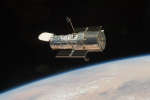 Hubble Floats Free
25.05.2009
Why put observatories in space? Most telescopes are on the ground. On the ground, you can deploy a heavier telescope and fix it more easily. The trouble is that Earth-bound telescopes must look through the Earth's atmosphere.
 Earths Major Telescopes Investigate GRB 130427A
8.05.2013
A tremendous explosion has occurred in the nearby universe and major telescopes across Earth and space are investigating. Dubbed GRB 130427A, the gamma-ray burst was first seen by the Earth-orbiting Swift satellite in high energy X-rays and quickly reported down to Earth.
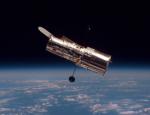 Hubble Floats Free
6.03.1997
Why put observatories in space? Most telescopes are on the ground. On the ground, you can deploy a heavier telescope and upgrade it more easily. The trouble is that Earth-bound telescopes must look through the Earth's atmosphere.
|
January February March April May June July August September October |
|||||||||||||||||||||||||||||||||||||||||||||||||