
|
You entered: merging galaxies
 Animation: Odd Radio Circles
30.03.2022
What do you call a cosmic puzzle that no one expected to see? In this case, Odd Radio Circles, aka ORCs. ORC-1 typifies the enigmatic five objects, only visible at radio frequencies, that were serendipitously discovered in 2019 using the new Australian SKA Pathfinder radio array.
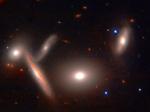 Hickson Compact Group 40
17.02.1999
Galaxies, like stars, frequently form groups. A group of galaxies is a system containing more than two galaxies but less than the tens or hundreds typically found in a cluster of galaxies. A most...
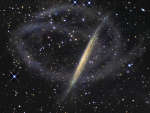 The Star Streams of NGC 5907
16.11.2019
Grand tidal streams of stars seem to surround galaxy NGC 5907. The arcing structures form tenuous loops extending more than 150,000 light-years from the narrow, edge-on spiral, also known as the Splinter or Knife Edge Galaxy.
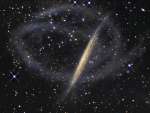 The Star Streams of NGC 5907
19.06.2008
Grand tidal streams of stars seem to surround galaxy NGC 5907. The arcing structures form tenuous loops extending more than 150,000 light-years from the narrow, edge-on spiral, also known as the Splinter or Knife Edge Galaxy.
 A Quasar-Galaxy Collision?
22.10.1995
In 1963 astronomers were astounded to discover that certain faint, star-like objects have very large redshifts. The large redshifts imply that these objects, now known as quasars (QUASi-stellAR objects), lie near the edge of the observable Universe.
 APOD: 2023 May 3 Б Centaurus A: A Peculiar Island of Stars
3.05.2023
Galaxies are fascinating. In galaxies, gravity alone holds together massive collections of stars, dust, interstellar gas, stellar remnants and dark matter. Pictured is NGC 5128, better known as Centaurus A. Cen A is the fifth brightest galaxy on the sky and is located at a distance of about 12 million light years from Earth.
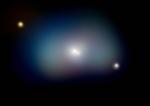 NGC 1700: Elliptical Galaxy and Rotating Disk
16.01.2003
In spiral galaxies, majestic winding arms of young stars and interstellar gas and dust rotate in a disk around a bulging galactic nucleus. Elliptical galaxies seem to be simpler, randomly swarming with old stars and lacking gas and dust.
 Galaxy Evolution Tracking Animation
30.05.2016
How did the universe evolve from such a smooth beginning? To help understand, computational cosmologists and NASA produced the featured time-lapse animated video depicting a computer simulation of part of the universe. The 100-million light-year simulation starts about 20 million years after the Big Bang and runs until the present.
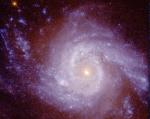 Spiral Galaxy NGC 3310 in Ultraviolet
17.01.2001
Why is NGC 3310 bursting with young stars? The brightest of these new stars are so hot that they light up this spiral galaxy not only in blue light, but in light so blue humans can't see it: ultraviolet. The Hubble Space Telescope took the above photograph in different bands of ultraviolet light.
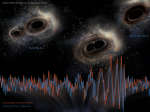 LIGO Detects Gravitational Waves from Merging Black Holes
11.02.2016
Gravitational radiation has been directly detected. The first-ever detection was made by both facilities of the Laser Interferometer Gravitational-Wave Observatory (LIGO) in Washington and Louisiana simultaneously last September. After numerous consistency checks, the resulting 5-sigma discovery was published today.
|
January February March April May June July |
|||||||||||||||||||||||||||||||||||||||||||||||||