
|
You entered: neutron
 Fermi s Gamma ray Pulsars
9.07.2009
Born in supernovae, pulsars are spinning neutron stars, collapsed stellar cores left from the death explosions of massive stars. Traditionally identified and studied by observing their regular radio pulsations, two dozen pulsars have now been detected at extreme gamma-ray energies by the Fermi Gamma-ray Space Telescope.
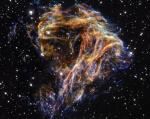 N49's Cosmic Blast
6.03.2004
Scattered debris from a cosmic supernova explosion lights up the sky in this gorgeous composited image based on data from the Hubble Space Telescope. Cataloged as N49, these glowing filaments of shocked gas span about 30 light-years in our neighboring galaxy, the Large Magellanic Cloud.
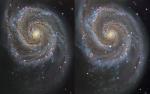 A Nearby Supernova in M51
19.07.2005
One of the nearest supernovas of recent years was discovered late last month in the bright nearby galaxy M51. It is visible on the right of the above before and after images of the picturesque spiral. Can you spot it?
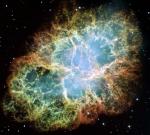 Crab Nebula Mosaic from HST
2.12.2005
The Crab Nebula is cataloged as M1, the first object on Charles Messier's famous list of things which are not comets. In fact, the cosmic Crab is now known to be a supernova remnant, an expanding cloud of debris from the death explosion of a massive star.
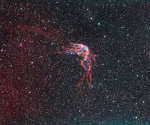 RCW 86: Historical Supernova Remnant
28.05.2022
In 185 AD, Chinese astronomers recorded the appearance of a new star in the Nanmen asterism. That part of the sky is identified with Alpha and Beta Centauri on modern star charts. The new star was visible for months and is thought to be the earliest recorded supernova.
 NGC 4993: The Galactic Home of an Historic Explosion
23.10.2017
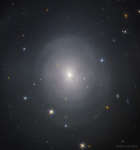
That reddish dot -- it wasn't there before. It's the dot to the upper left of galaxy NGC 4993's center, do you see it? When scanning the large field of possible locations...
 The Vela Pulsar s Dynamic Jet
3.07.2003
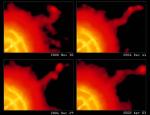
The Vela pulsar is a neutron star born over 10,000 years ago in a massive supernova explosion. Above, false-color x-ray images from the Chandra Observatory reveal details of this remnant pulsar's x-ray bright nebula along with emission from a spectacular jet of high-energy particles.
 APOD: 2024 February 27 Б Supernova Remnant Simeis 147
27.02.2024
It's easy to get lost following the intricate, looping, and twisting filaments of supernova remnant Simeis 147. Also cataloged as Sharpless 2-240, the filamentary nebula goes by the popular nickname the Spaghetti Nebula.
 Water Ice Detected Beneath Moons Surface
25.10.2010
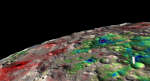
Is there enough water on the moon to sustain future astronauts? The question has important implications if humanity hopes to use the Moon as a future outpost. Last year, to help find out, scientists crashed the moon-orbiting LCROSS spacecraft into a permanently shadowed crater near the Moon's South Pole.
 The Once and Future Stars of Andromeda
20.01.2011
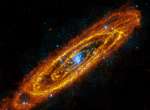
The big, beautiful Andromeda Galaxy, aka M31, is a spiral galaxy a mere 2.5 million light-years away. Two space-based observatories have combined to produce this intriguing composite image of Andromeda, at wavelengths outside the visible spectrum. The remarkable view follows the locations of this galaxy's once and future stars.
|
January February March April May June July August |
||||||||||||||||||||||||||||||||||||||||||||||||||||||||