
|
You entered: reflection nebula
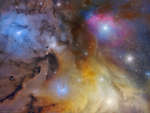 Stars, Dust, and Gas Near Antares
26.01.2022
Why is the sky near Antares and Rho Ophiuchi so dusty yet colorful? The colors result from a mixture of objects and processes. Fine dust -- illuminated from the front by starlight -- produces blue reflection nebulae. Gaseous clouds whose atoms are excited by ultraviolet starlight produce reddish emission nebulae.
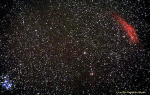 Seven Sisters Versus California
18.06.1996
In the lower left corner, dressed in blue, is the Pleiades. Also known as the Seven Sisters and M45, the Pleiades is one of the brightest and most easily visible open clusters on the sky. The Pleiades contains over 3000 stars, is about 400 light years away, and only 13 light years across.
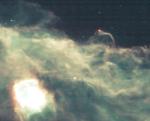 Infrared Horsehead
24.02.2001
This famous cosmic dust cloud was imaged in infrared light by the European Space Agency's Infrared Space Observatory (ISO) satellite. The false-color picture shows the bright infrared emission from dust and molecular gas in part of the Orion star forming region surrounding the Horsehead Nebula.
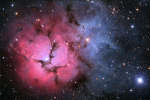 The Trifid Nebula in Stars and Dust
7.07.2009
Unspeakable beauty and unimaginable bedlam can be found together in the Trifid Nebula. Also known as M20, this photogenic nebula is visible with good binoculars towards the constellation of Sagittarius. The energetic processes of star formation create not only the colors but the chaos. The red-glowing gas results from high-energy starlight striking interstellar hydrogen gas.
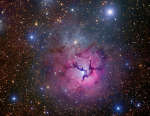 The Trifid Nebula is Stars and Dust
28.07.2010
Unspeakable beauty and unimaginable bedlam can be found together in the Trifid Nebula. Also known as M20, this photogenic nebula is visible with good binoculars towards the constellation of Sagittarius. The energetic processes of star formation create not only the colors but the chaos. The red-glowing gas results from high-energy starlight striking interstellar hydrogen gas.
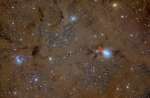 Stardust in Perseus
4.02.2010
This cosmic expanse of dust, gas, and stars covers close to 3 degrees on the sky in the heroic constellation Perseus. Right of center in the gorgeous skyscape is the dusty blue reflection nebula NGC 1333, about 1,000 light-years away. At that estimated distance, the field of view is about 50 light-years across.
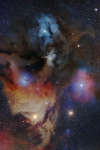 APOD: 2026 July 1 Б The Cotton Candy Clouds of Rho Ophiuchi
1.07.2026
Although they look like cotton candy, you cannot eat these clouds! Taken in Cádiz, Spain, today's image features the Rho Ophiuchi complex, a rich tapestry of young and old astronomical phenomena. This colorful cloud complex is a nearby star-forming region containing hundreds of young stellar objects, including protostars and T Tauri stars.
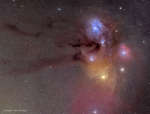 The Dark River to Antares
21.02.2015
Connecting the Pipe Nebula to the colorful region near bright star Antares is a dark cloud dubbed the Dark River, flowing from the picture's left edge. Murky looking, the Dark River's appearance is caused by dust obscuring background starlight, although the dark nebula contains mostly hydrogen and molecular gas.
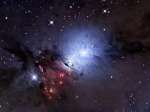 NGC 1333 Stardust
18.04.2009
NGC 1333 is seen in visible light as a reflection nebula, dominated by bluish hues characteristic of starlight reflected by dust. A mere 1,000 light-years distant toward the heroic constellation Perseus, it lies at the edge of a large, star-forming molecular cloud.
 APOD: 2024 September 3 Б Quarter Moon and Sister Stars
3.09.2024
Nine days ago, two quite different sky icons were imaged rising together. Specifically, Earth's Moon shared the eastern sky with the sister stars of the Pleiades cluster, as viewed from Alberta, Canada. Astronomical...
|
January February March April May June July August September |
|||||||||||||||||||||||||||||||||||||||||||||||||