
|
You entered: southern sky
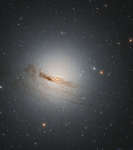 Threads of NGC 1947
7.04.2021
Found in far southern skies, deep within the boundaries of the constellation Dorado, NGC 1947 is some 40 million light-years away. In silhouette against starlight, obscuring lanes of cosmic dust thread across the peculiar galaxy's bright central regions.
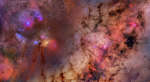 Scorpius Enhanced
16.06.2021
If Scorpius looked this good to the unaided eye, humans might remember it better. Scorpius more typically appears as a few bright stars in a well-known but rarely pointed out zodiacal constellation. To get a spectacular image like this, though, one needs a good camera, a dark sky, and some sophisticated image processing.
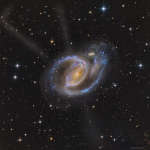 In the Arms of NGC 1097
16.11.2022
Spiral galaxy NGC 1097 shines in southern skies, about 45 million light-years away in the heated constellation Fornax. Its blue spiral arms are mottled with pinkish star forming regions in this colorful galaxy portrait.
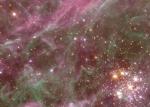 Denizen of the Tarantula Nebula
7.04.1999
The star cluster at lower right, cataloged as Hodge 301, is a denizen of the Tarantula Nebula. An evocative nebula in the southern sky, the sprawling cosmic Tarantula is an energetic star forming region some 168,000 light-years distant in our neighboring galaxy the Large Magellanic Cloud.
 Introducing Nova Velorum 1999
24.05.1999
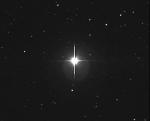
A bright nova was discovered Saturday that is currently visible to the unaided eye in southern skies. Nova Velorum 1999 was recorded near visual magnitude 3 independently by discoverers Peter Williams and Alan C. Gilmore (Mt. John U. Obs.), making it more luminous than many famous bright stars.
 McNaught s Matinee
19.01.2007
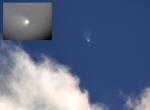
Comets grow bright when they're close to the Sun, basking in the intense solar radiation. Of course, they're also usually impossible to see against the overwhelming scattered sunlight. But surprising Comet McNaught...
 NGC 346 in the Small Magellanic Cloud
18.01.2005
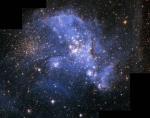
A satellite galaxy of the Milky Way, the Small Magellanic Cloud (SMC) is a wonder of the southern sky, a mere 210,000 light-years distant in the constellation Tucana. Found among the SMC's clusters and nebulae NGC 346 is a star forming region about 200 light-years across, pictured above by the Hubble Space Telescope.
 APOD: 2024 April 29 Б Comet, Planet, Moon
29.04.2024
Three bright objects satisfied seasoned stargazers of the western sky just after sunset earlier this month. The most familiar was the Moon, seen on the upper left in a crescent phase. The rest of the Moon was faintly visible by sunlight first reflected by the Earth.
 Tyrrhenian Sea and Solstice Sky
20.12.2014
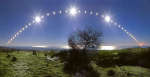
Today the solstice occurs at 23:03 Universal Time, the Sun reaching its southernmost declination in planet Earth's sky. Of course, the December solstice marks the beginning of winter in the northern hemisphere and summer in the south.
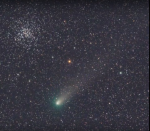 Salt Pepper and Ice
18.09.2018
There's a "camera" comet now moving across the sky. Just a bit too dim to see with the unaided eye, Comet 21P / Giacobini-Zinner has developed a long tail that makes it a good sight for binoculars and sensitive cameras.
|
January February March April May June July August September |
|||||||||||||||||||||||||||||||||||||||||||||||||