
|
You entered: star trail
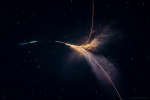 Falcon 9 Boostback
12.03.2020
Short star trails appear in this single 84 second long exposure, taken on March 6 from a rotating planet. The remarkable scene also captures the flight of a Falcon 9 rocket and Dragon cargo spacecraft over Cape Canaveral Air Force Station shortly after launch, on a resupply mission bound for the International Space Station.
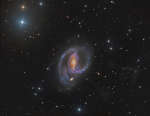 The Jets of NGC 1097
14.11.2013
Enigmatic spiral galaxy NGC 1097 shines in southern skies, about 45 million light-years away in the chemical constellation Fornax. Its blue spiral arms are mottled with pinkish star forming regions in this colorful galaxy portrait.
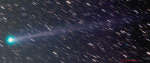 Comet McNaught Becoming Visible to the Unaided Eye
7.06.2010
A new comet is brightening and is now expected to become visible to the unaided eye later this month. C/2009 R1 (McNaught) is already showing an impressive tail and is currently visible through binoculars.
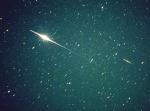 Iridium Flare
2.04.1998
Have you seen an Iridium flare? Satellites in low Earth orbit reflect sunlight and are often visible gliding across early evening and predawn skies. But sun glints from Iridium commercial digital communications satellites are providing the most spectacular sightings.
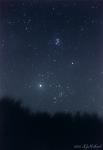 September Sky
29.09.2000
Star clusters, planets, and a red giant posed for this portrait of the night sky from rural Jasper County, Iowa, USA. Astrophotographer Stan Richard recorded the four minute time exposure looking east around midnight on September 3rd at Ashton-Wildwood Park.
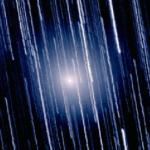 Tempel Tuttle: The Leonid Comet
16.11.2002
Star trails streak this composite time exposure of comet Tempel-Tuttle recorded by Tim Puckett on January 26, 1998. Then passing through the inner solar system on its 33 year orbit around the Sun, Tempel-Tuttle brightened unexpectedly, but binoculars or small telescopes were still required to visually observe it.
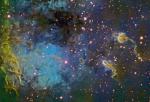 The Tadpoles of IC 410
11.01.2006
This close-up view shows a portion of otherwise faint emission nebula IC 410 in striking false-colors. It also shows two remarkable denizens of the glowing gas cloud at the right - the "tadpoles" of IC 410. The picture is a composite of images taken through narrow band filters intended to trace atoms in the nebula.
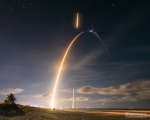 Launch and Landing
13.01.2018
A composite of three consecutive exposures, this night skyscape follows the January 7 launch and first stage landing of a Falcon 9 rocket from a beach on planet Earth's space coast. With...
 Comet Stonehouse
14.05.1998
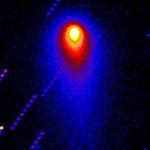
Comets move against a field of background stars. Their apparent motion is slow but carefull tracking reveals their orbits, allowing these visitors to the inner solar system to be identified as old or new acquaintances. Recently a new comet, designated 1998 H1, was discovered by observer Patrick L.
 In the Arms of NGC 1097
8.01.2015
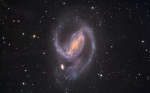
Spiral galaxy NGC 1097 shines in southern skies, about 45 million light-years away in the chemical constellation Fornax. Its blue spiral arms are mottled with pinkish star forming regions in this colorful galaxy portrait.
|
January February March April May June July August September |
|||||||||||||||||||||||||||||||||||||||||||||||||