
|
You entered: surface
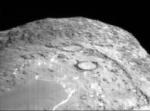 The Landscape on Comet Tempel 1
6.07.2005
This diverse landscape is the surface of comet Temple 1's nucleus as seen by the Deep Impact probe's Impactor Targeting Sensor. Within minutes of recording the rugged view, the landscape had changed dramatically though, as the impactor smashed into the surface near the two large, half kilometer-sized craters at picture center.
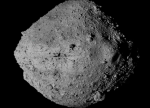 Places for OSIRIS REx to Touch Asteroid Bennu
23.12.2019
Where is the best place to collect a surface sample from asteroid Bennu? Launched in 2016, NASA sent the robotic Origins, Spectral Interpretation, Resource Identification, Security, Regolith Explorer (OSIRIS-REx) to investigate the 500-meter-across asteroid 101955 Bennu.
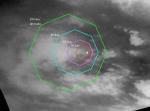 Descent to Titan
14.01.2005
Today's descent to the surface of Titan by the European Space Agency's Huygens probe is the most distant landing ever attempted by a spacecraft from Earth. At 10:13 UT (5:13am...
 A Martian Metamorphosis
4.06.2002
Is it an Escher, or Mars? Three different types of surfaces visible in the North Polar Cap of Mars morph into each other in a way perhaps reminiscent of the works of M. C. Escher. On the far left dark sand covers the ground, while the center shows a transition to a dune field.
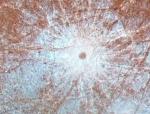 Pwyll: Icy Crater of Europa
13.04.2002
The impact crater Pwyll (a name from Celtic Mythology) is thought to represent one of the youngest features on the surface of Jupiter's moon Europa. A combination of color and high resolution black...
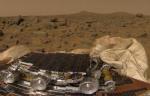 A Landing On Mars
4.07.1999
On July 4th, 1997 - using its own array of fireworks, a parachute, and airbags - the Mars Pathfinder spacecraft successfully came to rest on the surface of Mars at 10:07 AM Pacific Daylight Time. Ninety minutes before reaching the surface Pathfinder began a flurry of activity.
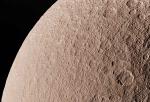 Rhea: Saturns Second Largest Moon
5.12.1999
Rhea is the second largest moon of Saturn, behind Titan, and the largest without an atmosphere. It is composed mostly of water ice, but has a small rocky core. Rhea's rotation and orbit are locked together (just like Earth's Moon) so that one side always faces Saturn.
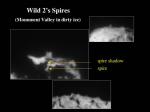 Unusual Spires Found on Comet Wild 2
22.06.2004
How did unusual spires form on comet Wild 2? Close inspection of images taken of Comet Wild 2 by the passing Stardust spacecraft in January show numerous strange pinnacles as long as 100 meters long jutting off the surface. The pinnacles were unexpected - close-ups of other comets and asteroids show no such features.
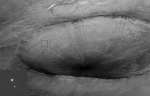 Descent of the Phoenix
30.05.2008
In this sweeping view, the 10 kilometer-wide crater Heimdall lies on the north polar plains of Mars. But the bright spot highlighted in the inset is the Phoenix lander parachuting toward the surface. The amazing picture was captured on May 25th by the HiRISE camera onboard the Mars Reconnaissance Orbiter.
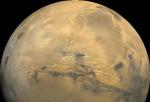 Mars: Just The Facts
27.06.1997
Mars, the freeze-dried planet, orbits 137 million miles from the Sun or at about 1.5 times the Earth-Sun distance. It has two diminutive moons, towering extinct volcanos, an immense canyon system, a thin atmosphere...
|
January February March April May June July August September October |
|||||||||||||||||||||||||||||||||||||||||||||||||