
|
You entered: image
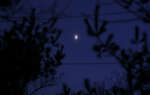 An Unusual Venusian Oval
13.02.2012
Why would Venus appear oval? Venus has been seen countless times from the surface of the Earth, and every time the Earth's atmosphere has dispersed its light to some degree. When...
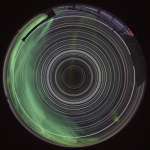 South Pole Star Trails
2.08.2012
No star dips below the horizon and the Sun never climbs above it in this remarkable Lewin's Challenge image of 24 hour long star trails. Showing all the trails as complete circles, such an image could be achieved only from two places on planet Earth.
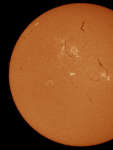 A Transit of Mercury
11.05.2016
On May 9, the diminutive disk of Mercury spent about seven and a half hours crossing in front of the Sun as viewed from the general vicinity of Earth. It was the second of 14 transits of the Solar System's innermost planet in the 21st century.
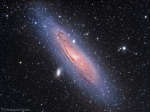 M31: The Andromeda Galaxy
26.12.2016
What is the nearest major galaxy to our own Milky Way Galaxy? Andromeda. In fact, our Galaxy is thought to look much like Andromeda. Together these two galaxies dominate the Local Group of galaxies. The diffuse light from Andromeda is caused by the hundreds of billions of stars that compose it.
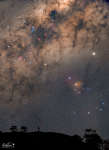 The Galaxy Above
14.10.2019
Have you contemplated your home galaxy lately? If your sky looked like this, perhaps you'd contemplate it more often! The featured picture is actually a composite of two images taken last month from the same location in south Brazil and with the same camera -- but a few hours apart.
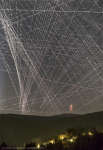 APOD: 2026 April 27 Б Comet R3 PanSTARRS Behind Satellite Trails
26.04.2026
Can you find the comet? Somewhere through this web of satellite trails is Comet C/2025 R3 (PanSTARRS), a bright visitor passing through the inner Solar System. Now, the orbiting satellites themselves only appear as streaks because of the long camera exposure, over 10 minutes in this case.
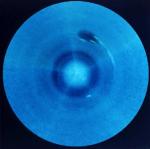 Southern Neptune
27.06.1998
Neptune, the Solar System's outermost gas giant planet, is 30 times farther from the Sun than Earth. Twelve years after a 1977 launch, Voyager 2 flew by Neptune and found surprising activity on a planet that receives only 3 percent as much sunlight as Jupiter.
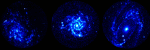 A Spiral Galaxy Gallery
13.03.1998
A progression of beautiful spiral galaxies is illustrated above with three photographs from NASA's Ultraviolet Imaging Telescope (UIT). Flying above the Earth's obscuring layer of atmosphere on the Space Shuttle Columbia during...
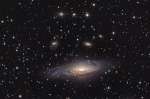 NGC 7331 and Beyond
24.10.2009
Big, beautiful spiral galaxy NGC 7331 is often touted as an analog to our own Milky Way. About 50 million light-years distant in the northern constellation Pegasus, NGC 7331 was recognized early on as a spiral nebula and is actually one of the brighter galaxies not included in Charles Messier's famous 18th century catalog.
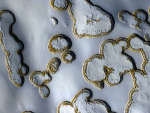 Dry Ice Pits on Mars
26.09.2011
Part of Mars is defrosting. Around the South Pole of Mars, toward the end of every Martian summer, the warm weather causes a section of the vast carbon-dioxide ice cap to evaporate. Pits begin to appear and expand where the carbon dioxide dry ice sublimates directly into gas.
|
January February March April May June July August September |
|||||||||||||||||||||||||||||||||||||||||||||||||