
|
You entered: Milky Way
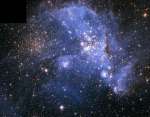 NGC 346 in the Small Magellanic Cloud
17.10.2010
How and why are all these stars forming? Found among the Small Magellanic Cloud's (SMC's) clusters and nebulae NGC 346 is a star forming region about 200 light-years across, pictured above by the Hubble Space Telescope.
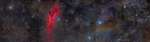 Clouds of Perseus
21.10.2011
Cosmic clouds of gas and dust drift across this magnificent panorama, spanning some 17 degrees near the southern boundary of the heroic constellation Perseus. The collaborative skyscape begins with bluish stars of Perseus at the left, but the eye is drawn to the striking, red NGC 1499.
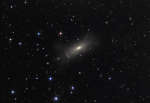 Shell Galaxy NGC 7600
23.12.2011
Similar in size to the Milky Way, elliptical galaxy NGC 7600 is about 150 thousand light-years distant. In this deep image, spanning about 1/2 degree on the sky toward the constellation Aquarius, NGC 7600 sports a remarkable outer halo of nested shells and broad circumgalactic structures.
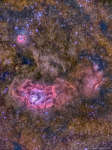 Deep Field: Nebulae of Sagittarius
21.05.2019
These three bright nebulae are often featured on telescopic tours of the constellation Sagittarius and the crowded starfields of the central Milky Way. In fact, 18th century cosmic tourist Charles Messier cataloged two of them; M8, the large nebula just left of center, and colorful M20 on the top left.
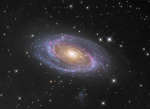 Messier 81
12.03.2021
One of the brightest galaxies in planet Earth's sky is similar in size to our Milky Way Galaxy: big, beautiful Messier 81. Also known as NGC 3031 or Bode's galaxy for its 18th century discoverer, this grand spiral can be found toward the northern constellation of Ursa Major, the Great Bear.
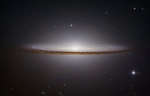 Messier 104
23.04.2022
A gorgeous spiral galaxy, Messier 104 is famous for its nearly edge-on profile featuring a broad ring of obscuring dust lanes. Seen in silhouette against an extensive central bulge of stars, the swath of cosmic dust lends a broad brimmed hat-like appearance to the galaxy suggesting a more popular moniker, the Sombrero Galaxy.
 Open Star Clusters M35 and NGC 2158
27.02.2025
Framed in this single, starry, telescopic field of view are two open star clusters, M35 and NGC 2158. Located within the boundaries of the constellation Gemini, they do appear to be side by side. Its stars concentrated toward the upper right, M35 is relatively nearby, though.
 APOD: 2025 June 26 Б The Seagull Nebula
26.06.2025
An interstellar expanse of glowing gas and obscuring dust presents a bird-like visage to astronomers from planet Earth, suggesting its popular moniker, the Seagull Nebula. This broadband portrait of the cosmic bird covers...
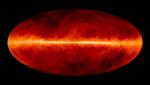 A Sky Full Of Hydrogen
13.01.2001
Interstellar space is filled with extremely tenuous clouds of gas which are mostly Hydrogen. The neutral hydrogen atom (HI in astronomer's shorthand) consists of 1 proton and 1 electron. The proton and electron spin like tops but can have only two orientations; spin axes parallel or anti-parallel.
 Perseids of Summer
10.08.2001
Like falling stardust, cast off bits of comet Swift-Tuttle hurtle through the upper atmosphere about this time each year as planet Earth passes near the comet's orbital path. For the northern hemisphere, this...
|
January February March April May June July August September October |
|||||||||||||||||||||||||||||||||||||||||||||||||