
|
You entered: ring
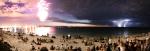 Comet Between Fireworks and Lightning
5.02.2007
Sometimes the sky itself is the best show in town. On January 26, people from Perth, Australia gathered on a local beach to watch a sky light up with delights near and far. Nearby, fireworks exploded as part of Australia Day celebrations. On the far right, lightning from a thunderstorm flashed in the distance.
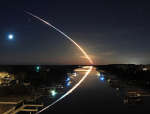 Waterway to Orbit
13.02.2010
The 32nd shuttle mission to the International Space Station, STS-130, left planet Earth on February 8. Its early morning launch to orbit from Kennedy Space Center's pad 39A followed the long, graceful, eastward arc seen in this 2 minute time exposure.
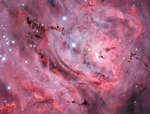 The Deep Lagoon
29.07.2015
Ridges of glowing interstellar gas and dark dust clouds inhabit the turbulent, cosmic depths of the Lagoon Nebula. Also known as M8, The bright star forming region is about 5,000 light-years distant.
 Moonrise Eclipse
2.02.2018
This atmospheric picture of a distant horizon looks toward the tall Trisul peaks of India's snowy Himalayan mountains. Taken from a remote location on January 31, brightest star Sirius shines at the upper right. The red Moon rising is gliding through Earth's shadow during the evening's much anticipated total lunar eclipse.
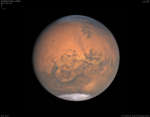 Close Mars
31.08.2018
Still bright in evening skies, Mars was just past opposition and closest to Earth on July 31, a mere 57.6 million kilometers away. Captured only a week later, this remarkable image shows...
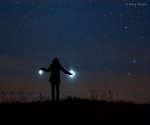 APOD: 2023 March 6 Б Jupiter and Venus from Earth
6.03.2023
It was visible around the world. The sunset conjunction of Jupiter and Venus in 2012 was visible almost no matter where you lived on Earth. Anyone on the planet with a clear western horizon at sunset could see them.
 APOD: 2023 April 18 Б Map of Total Solar Eclipse Path in 2024 April
18.04.2023
Would you like to see a total eclipse of the Sun? If so, do any friends or relatives live near the path of next April's eclipse? If yes again, then you might want to arrange a well-timed visit.
 Messier 4
29.11.2024
Messier 4 can be found west of bright red-giant star Antares, alpha star of the constellation Scorpius. M4 itself is only just visible from dark sky locations, even though the globular cluster of 100,000 stars or so is a mere 5,500 light-years away.
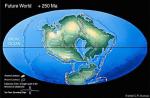 Pangea Ultima: Earth in 250 Million Years
2.10.2000
Is this what will become of the Earth's surface? The surface of the Earth is broken up into several large plates that are slowly shifting. About 250 million years ago, the plates...
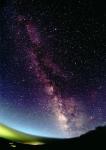 Heaven on Earth
6.11.2000
If sometimes it appears that the entire Milky Way Galaxy is raining down on your head, do not despair. It happens twice a day. As the Sun rises in the East, wonders of the night sky become less bright than the sunlight scattered by our own Earth's atmosphere, and so fade from view.
|
January February March April May June July August September October |
|||||||||||||||||||||||||||||||||||||||||||||||||