
|
You entered: outer Galaxy
 The Deep Field
24.01.1996
The image above is part of the Hubble Deep Field and represents humanity's most distant yet optical view of the Universe. Galaxies like colorful pieces of candy fill the field, some as faint as 30th magnitude (about four billion times fainter than stars visible to the unaided eye).
 APOD: 2024 July 22 Б Chamaeleon Dark Nebulas
22.07.2024
Sometimes the dark dust of interstellar space has an angular elegance. Such is the case toward the far-south constellation of Chamaeleon. Normally too faint to see, dark dust is best known for blocking visible light from stars and galaxies behind it.
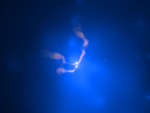 Two Black Holes Dancing in 3C 75
9.11.2008
What's happening at the center of active galaxy 3C 75? The two bright sources at the center of this composite x-ray (blue)/ radio (pink) image are co-orbiting supermassive black holes powering the giant radio source 3C 75.
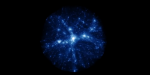 Dark Matter Movie from the Bolshoi Simulation
3.10.2011
What if you could fly through the universe and see dark matter? While the technology for taking such a flight remains under development, the technology for visualizing such a flight has taken a grand leap forward with the completion of the Bolshoi Cosmological Simulation.
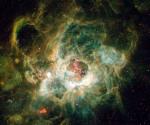 NGC 604: Giant Stellar Nursery
2.11.2002
Scattered within this cavernous nebula, cataloged as NGC 604, are over 200 newly formed hot, massive, stars. At 1,500 light-years across, this expansive cloud of interstellar gas and dust is effectively a giant stellar nursery located some three million light-years distant in the spiral galaxy, M33.
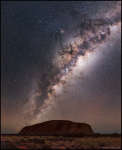 Milky Way over Uluru
30.07.2015
The central regions of our Milky Way Galaxy rise above Uluru/Ayers Rock in this striking night skyscape. Recorded on July 13, a faint airglow along the horizon shows off central Australia's most recognizable landform in silhouette.
 M51: Tidal Streams and H-alpha Ciffs
13.12.2024
An intriguing pair of interacting galaxies, M51 is the 51st entry in Charles Messier's famous catalog. Perhaps the original spiral nebula, the large galaxy with whirlpool-like spiral structure seen nearly face-on is also cataloged as NGC 5194. Its spiral arms and dust lanes sweep in front of its smaller companion galaxy, NGC 5195.
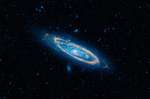 WISE Infrared Andromeda
19.02.2010
This sharp, wide-field view features infrared light from the spiral Andromeda Galaxy (M31). Dust heated by Andromeda's young stars is shown in yellow and red, while its older population of stars appears as a bluish haze. The false-color skyscape is a mosaic of images from NASA's new Wide-field Infrared Survey Explorer (WISE) satellite.
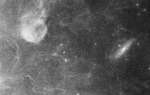 Sivan 2 to M31
3.03.2017
From within the boundaries of the constellation Cassiopeia (left) to Andromeda (right), this telescopic mosaic spans over 10 degrees in planet Earth's skies. The celestial scene is constructed of panels that are part of a high-resolution astronomical survey of the Milky Way in hydrogen-alpha light.
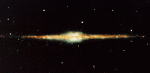 The Milky Way's Center
15.03.1997
Although the Earth is round, our Galaxy appears truly flat. This was shown in dramatic fashion by the COsmic Background Explorer (COBE) satellite which produced this premier view of the central region of our own Milky Way Galaxy in infrared light in1990.
|
January February March April May June July August September October |
|||||||||||||||||||||||||||||||||||||||||||||||||