
|
You entered: star cluster
 APOD: 2024 March 27 Б The Coma Cluster of Galaxies
27.03.2024
Almost every object in the featured photograph is a galaxy. The Coma Cluster of Galaxies pictured here is one of the densest clusters known - it contains thousands of galaxies. Each of these galaxies houses billions of stars - just as our own Milky Way Galaxy does.
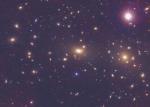 The Coma Cluster of Galaxies
12.10.2003
Almost every object in the above photograph is a galaxy. The Coma Cluster of Galaxies pictured above is one of the densest clusters known - it contains thousands of galaxies. Each of these galaxies houses billions of stars - just as our own Milky Way Galaxy does.
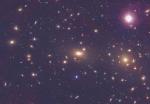 The Coma Cluster of Galaxies
28.03.1999
Almost every object in the above photograph is a galaxy. The Coma Cluster of Galaxies pictured is one of the densest clusters known - it contains thousands of galaxies. Each of these galaxies house billions of stars - just as our own Milky Way Galaxy does.
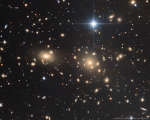 The Coma Cluster of Galaxies
26.03.2018
Almost every object in the above photograph is a galaxy. The Coma Cluster of Galaxies pictured here is one of the densest clusters known - it contains thousands of galaxies. Each of these galaxies houses billions of stars - just as our own Milky Way Galaxy does.
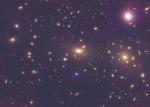 The Coma Cluster of Galaxies
6.08.2000
Almost every object in the above photograph is a galaxy. The Coma Cluster of Galaxies pictured above is one of the densest clusters known - it contains thousands of galaxies. Each of these galaxies houses billions of stars - just as our own Milky Way Galaxy
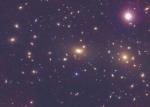 The Coma Cluster of Galaxies
3.02.2002
Almost every object in the above photograph is a galaxy. The Coma Cluster of Galaxies pictured above is one of the densest clusters known - it contains thousands of galaxies. Each of these galaxies houses billions of stars - just as our own Milky Way Galaxy does.
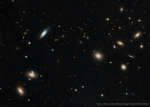 Inside the Coma Cluster of Galaxies
28.02.2015
Almost every object in the above photograph is a galaxy. The Coma Cluster of Galaxies pictured above is one of the densest clusters known - it contains thousands of galaxies. Each of these galaxies houses billions of stars - just as our own Milky Way Galaxy does.
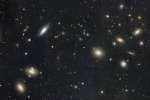 Inside the Coma Cluster of Galaxies
16.06.2008
Almost every object in the above photograph is a galaxy. The Coma Cluster of Galaxies pictured above is one of the densest clusters known - it contains thousands of galaxies. Each of these galaxies houses billions of stars - just as our own Milky Way Galaxy does.
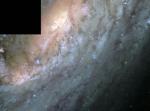 Barred Spiral Galaxy NGC 2903
21.03.2001
NGC 2903 is a spiral galaxy similar to our own Milky Way Galaxy. Similarities include its general size and a central bar. One striking difference, however, is the appearance of mysterious hot spots in NGC 2903's core. Upon
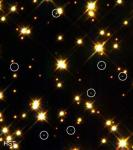 White Dwarf Stars Cool
2.11.1997
Diminutive by stellar standards, white dwarf stars are also intensely hot ... but they are cooling. No longer do their interior nuclear fires burn, so they will continue to cool until they fade away. This Hubble Space Telescope image covers a small region near the center of a globular cluster known as M4.
|
January February March April May June July August September October |
|||||||||||||||||||||||||||||||||||||||||||||||||