
|
You entered: Milky Way
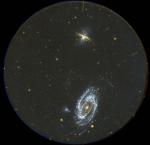 M81 and M82: GALEX Full Field
30.12.2004
Intriguing galaxy pair M81 and M82 shine in this full-field view from the orbiting GALEX observatory. GALEX - the Galaxy Evolution Explorer - scans the cosmos in ultraviolet light, a view that follows star formation and galaxy evolution through the Universe.
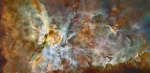 Carina Nebula Panorama from Hubble
24.05.2009
In one of the brightest parts of Milky Way lies a nebula where some of the oddest things occur. NGC 3372, known as the Great Nebula in Carina, is home to massive stars and changing nebula.
 Southern Geminids
18.12.2009
At least 34 meteors are included in this composite image as they rain through Australian skies during the annual Geminid Meteor shower. Dust particles strung out along the orbit of extinct comet Phaethon vaporize when they plow through planet Earth's atmosphere causing the impressive display.
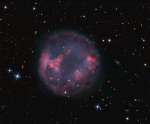 Planetary Nebula Abell 7
5.12.2013
Very faint planetary nebula Abell 7 is some 1,800 light-years distant, just south of Orion in planet Earth's skies in the constellation Lepus, The Hare. Surrounded by Milky Way stars and near...
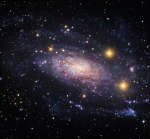 NGC 3621: Far Beyond the Local Group
24.02.2017
Far beyond the local group of galaxies lies NGC 3621, some 22 million light-years away. Found in the multi-headed southern constellation Hydra, the winding spiral arms of this gorgeous island universe are loaded with luminous blue star clusters, pinkish starforming regions, and dark dust lanes.
 APOD: 2025 June 24 Б In the Center of Spiral Galaxy M61
24.06.2025
Is there a spiral galaxy in the center of this spiral galaxy? Sort of. Image data from the Hubble Space Telescope, the European Southern Observatory, and smaller telescopes on planet Earth are combined in this detailed portrait of face-on spiral galaxy Messier 61 (M61) and its bright center.
 APOD: 2025 August 14 Б M13: The Great Globular Cluster in Hercules
14.08.2025
In 1716, English astronomer Edmond Halley noted, "This is but a little Patch, but it shews itself to the naked Eye, when the Sky is serene and the Moon absent." Of course...
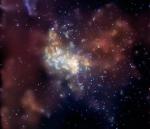 X Rays from the Galactic Core
8.01.2003
Using the orbiting Chandra X-ray Observatory, astronomers have taken this long look at the core of our Milky Way galaxy, some 26,000 light-years away. The spectacular false-color view spans about 130 light-years.
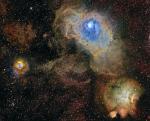 Three Nebulae in Narrow Band
2.11.2007
Narrow band filters and a false-color palette give these three nebulae a stunning appearance against the cosmic canvas of the central Milky Way. All three are stellar nurseries about 5,000 light-years or so distant, toward the nebula rich constellation Sagittarius.
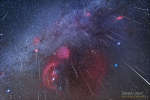 Geminids and Friends
15.12.2018
From a radiant in the constellation of the Twins, the annual Geminid meteor shower rained down on our fair planet this week. This beautiful skyscape collects about 70 of Gemini's lovely shooting stars in a digital composition made from multiple exposures.
|
January February March April May June July August September October |
|||||||||||||||||||||||||||||||||||||||||||||||||