
|
You entered: dust
 NGC6366 vs 47 Ophiuchi
23.05.2025
Most globular star clusters roam the halo of our Milky Way galaxy, but globular cluster NGC 6366 lies close to the galactic plane. About 12,000 light-years away toward the constellation Ophiuchus, the cluster's starlight is dimmed and reddened by the Milky Way's interstellar dust when viewed from planet Earth.
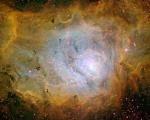 The Lagoon Nebula in Three Colors
20.08.2001
The bright Lagoon Nebula is home to a diverse array of astronomical objects. Particularly interesting sources include a bright open cluster of stars and several energetic star-forming regions. When viewed by eye, cluster light...
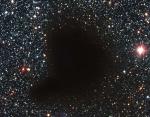 Molecular Cloud Barnard 68
23.09.2001
Where did all the stars go? What used to be considered a hole in the sky is now known to astronomers as a dark molecular cloud. Here, a high concentration of dust and molecular gas absorb practically all the visible light emitted from background stars.
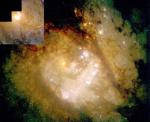 In the Center of Spiral Galaxy M83
6.11.2001
What's happening at the center of spiral galaxy M83? Just about everything, from the looks of it. M83, visible in the inset image on the upper left, is one of the closest spiral galaxies to our own Milky Way Galaxy and from a distance of 15 million light-years, appears to be relatively normal.
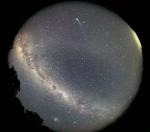 A Southern Sky View
10.03.2002
On 1996 March 22, a Galaxy and a comet shared the southern sky. They were captured together, from horizon to horizon, in the night sky above Loomberah, New South Wales, Australia by astronomer Gordon Garradd. Garradd used a home made all-sky camera with a fisheye lens, resulting in a circular 200 degree field of view.
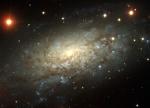 NGC 3621: Far Beyond the Local Group
5.06.2002
Far beyond the local group of galaxies lies NGC 3621, some 22 million light-years away. Found in the serpentine southern constellation Hydra, the loose spiral arms of this gorgeous island universe are loaded with luminous young star clusters and dark dust lanes.
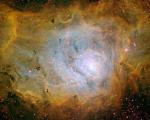 The Lagoon Nebula in Three Colors
6.10.2002
The bright Lagoon Nebula is home to a diverse array of astronomical objects. Particularly interesting sources include a bright open cluster of stars and several energetic star-forming regions. When viewed by eye, cluster light...
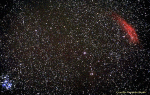 Seven Sisters Versus California
18.06.1996
In the lower left corner, dressed in blue, is the Pleiades. Also known as the Seven Sisters and M45, the Pleiades is one of the brightest and most easily visible open clusters on the sky. The Pleiades contains over 3000 stars, is about 400 light years away, and only 13 light years across.
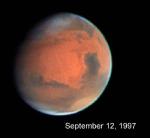 A Martian Autumn Begins
23.09.1997
Today is the first day of Autumn in the Northern Hemisphere of Planet Earth. The Autumnal Equinox occured yesterday at 7:56 pm EDT as the Sun crossed the celestial equator from North to South.
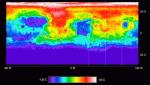 Thermal Mars
2.06.1999
It's 2 AM on Mars and surface temperatures range from -65C to -120C, as measured by the Thermal Emission Spectrometer (TES) onboard the Mars Global Surveyor spacecraft. TES data used...
|
January February March April May June July August September October |
|||||||||||||||||||||||||||||||||||||||||||||||||