
|
You entered: galaxies
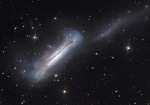 Portrait of NGC 3628
3.06.2020
Sharp telescopic views of NGC 3628 show a puffy galactic disk divided by dark dust lanes. Of course, this deep portrait of the magnificent, edge-on spiral galaxy puts some astronomers in mind of its popular moniker, the Hamburger Galaxy.
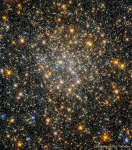 Palomar 6: Globular Star Cluster
18.10.2021
Where did this big ball of stars come from? Palomar 6 is one of about 200 globular clusters of stars that survive in our Milky Way Galaxy. These spherical star-balls are older than our Sun as well as older than most stars that orbit in our galaxy's disk.
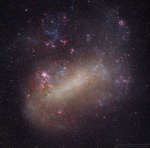 The Large Cloud of Magellan
28.05.2013
The 16th century Portuguese navigator Ferdinand Magellan and his crew had plenty of time to study the southern sky during the first circumnavigation of planet Earth. As a result, two fuzzy cloud-like objects easily...
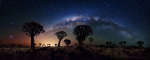 Milky Way Over Quiver Tree Forest
12.12.2012
In front of a famous background of stars and galaxies lies some of Earth's more unusual trees. Known as quiver trees, they are actually succulent aloe plants that can grow to tree-like proportions. The quiver tree name is derived from the historical usefulness of their hollowed branches as dart holders.
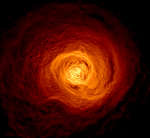 The Perseus Cluster Waves
3.05.2017
The cosmic swirl and slosh of giant waves in an enormous reservoir of glowing hot gas are traced in this enhanced X-ray image from the Chandra Observatory. The frame spans over 1 million light-years across the center of the nearby Perseus Galaxy Cluster, some 240 million light-years distant.
 Crepuscular Moon Rays over Denmark
26.07.2022
This moon made quite an entrance. Typically, a moonrise is quiet and serene. Taking a few minutes to fully peek above the horizon, Earth's largest orbital companion can remain relatively obscure until it rises high in the nighttime sky.
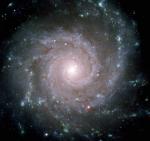 M74: The Perfect Spiral
24.05.2003
If not perfect, then this spiral galaxy is at least one of the most photogenic. An island universe of about 100 billion stars, 30 million light-years away toward the constellation Pisces, NGC 628 or M74 presents a gorgeous face-on view to earthbound astronomers.
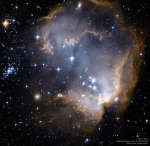 NGC 602 and Beyond
15.05.2021
The clouds may look like an oyster, and the stars like pearls, but look beyond. Near the outskirts of the Small Magellanic Cloud, a satellite galaxy some 200 thousand light-years distant, lies 5 million year young star cluster NGC 602.
 APOD: 2024 October 29 Б NGC 602: Stars Versus Pillars from Webb
28.10.2024
The stars are destroying the pillars. More specifically, some of the newly formed stars in the image center are emitting light so energetic that is evaporating the gas and dust in the surrounding pillars. Simultaneously, the pillars themselves are still trying to form new stars.
 APOD: 2025 November 19 Б Chamaeleon Dark Nebulas
18.11.2025
Sometimes the dark dust of interstellar space has an angular elegance. Such is the case toward the far-south constellation of Chamaeleon. Normally too faint to see, dark dust is best known for blocking visible light from stars and galaxies behind it.
|
January February March April May June July August September October |
|||||||||||||||||||||||||||||||||||||||||||||||||