
|
You entered: Earth orbit
 In Chandor Chasma on Mars
31.05.2002
Scroll right and dive into a spectacular canyon on Mars. This daytime infrared view, recently recorded by the THEMIS camera on board the orbiting Mars Odyssey spacecraft, covers a 30 by 175 kilometer swath running along the canyon floor.
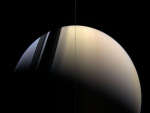 Saturn in Blue and Gold
13.04.2014
Why is Saturn partly blue? The above picture of Saturn approximates what a human would see if hovering close to the giant ringed world. The above picture was taken in 2006 March by the robot Cassini spacecraft now orbiting Saturn. Here Saturn's majestic rings appear directly only as a thin vertical line.
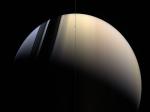 Saturn in Blue and Gold
3.05.2006
Why is Saturn partly blue? The above picture of Saturn approximates what a human would see if hovering close to the giant ringed world. The above picture was taken in mid-March by the robot Cassini spacecraft now orbiting Saturn. Here Saturn's majestic rings appear directly only as a thin vertical line.
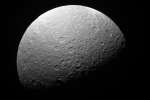 Ancient Craters of Southern Rhea
13.05.2008
Saturn's ragged moon Rhea has one of the oldest surfaces known. Estimated as changing little in the past billion years, Rhea shows craters so old they no longer appear round their edges have become compromised by more recent cratering.
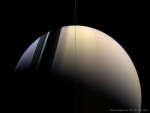 Saturn in Blue and Gold
29.08.2017
Why is Saturn partly blue? The featured picture of Saturn approximates what a human would see if hovering close to the giant ringed world. The image was taken in 2006 March by the robot Cassini spacecraft now orbiting Saturn. Here Saturn's majestic rings appear directly only as a thin vertical line.
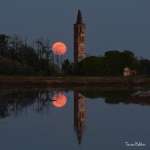 Full Flower Moonrise
9.05.2020
Rising as the Sun set, the Moon was bright and full in planet Earth skies on May 7 and known to some as a Flower Moon. Near the horizon it does seem to take on rose pink hues of reddened sunlight in this reflective twilight scene.
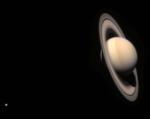 Cassini Approaches Saturn
4.11.2002
Cassini, a robot spacecraft launched in 1997 by NASA, is close enough now to resolve many rings and moons of its destination planet: Saturn. The spacecraft has closed to about two Earth-Sun separations from the ringed giant. Last month, Cassini snapped several images during an engineering test.
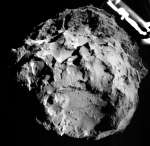 Descent to a Comet
12.11.2014
Yesterday, the first soft landing on a comet took place some 500 million kilometers from planet Earth as the Rosetta mission lander Philae settled on the nucleus of C67/P Churyumov-Gerasimenko. The landing site, dubbed Agilkia, is located near the center of this remarkable image snapped by Philae's ROLIS (ROsetta Lander Imaging System) camera.
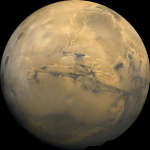 Valles Marineris: The Grand Canyon of Mars
27.03.2011
The largest canyon in the Solar System cuts a wide swath across the face of Mars. Named Valles Marineris, the grand valley extends over 3,000 kilometers long, spans as much as 600 kilometers across, and delves as much as 8 kilometers deep.
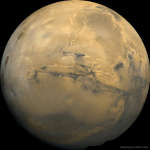 Valles Marineris: The Grand Canyon of Mars
24.05.2020
The largest canyon in the Solar System cuts a wide swath across the face of Mars. Named Valles Marineris, the grand valley extends over 3,000 kilometers long, spans as much as 600 kilometers across, and delves as much as 8 kilometers deep.
|
January February March April May June July August September October |
|||||||||||||||||||||||||||||||||||||||||||||||||