
|
You entered: cluster
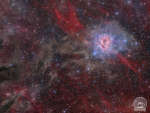 Cocoon Nebula Deep Field
18.09.2018
Inside the Cocoon Nebula is a newly developing cluster of stars. The cosmic Cocoon on the upper right also punctuates a long trail of obscuring interstellar dust clouds to its left. Cataloged...
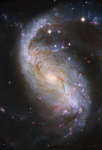 NGC 1672: Barred Spiral Galaxy from Hubble
5.04.2020
Many spiral galaxies have bars across their centers. Even our own Milky Way Galaxy is thought to have a modest central bar. Prominently barred spiral galaxy NGC 1672, featured here, was captured in spectacular detail in an image taken by the orbiting Hubble Space Telescope.
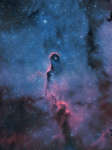 The Elephant's Trunk Nebula in Cepheus
31.07.2020
Like an illustration in a galactic Just So Story, the Elephant's Trunk Nebula winds through the emission nebula and young star cluster complex IC 1396, in the high and far off constellation of Cepheus. Also known as vdB 142, the cosmic elephant's trunk is over 20 light-years long.
 Andromeda in a Single Shot
24.06.2021
How far can you see? The Andromeda Galaxy, 2.5 million light years away, is the most distant object easily seen by the unaided eye. Other denizens of the night sky, like stars, clusters, and nebulae, are typically hundreds to thousands of light-years distant.
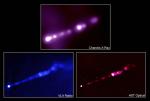 M87 s Energetic Jet
31.10.2001
An energetic jet from the core of giant elliptical galaxy M87 stretches outward for 5,000 light-years. This monstrous jet appears in the panels above to be a knotted and irregular structure, dectected across the spectrum, from x-ray to optical to radio wavelengths.
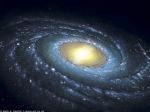 Milky Way Illustrated
3.01.2005
What does our Milky Way Galaxy look like from afar? Since we are stuck inside, and since opaque dust truncates our view in visible light, nobody knows for sure. Drawn above, however, is a good guess based on many different types of observations.
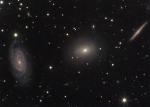 Three Galaxies in Draco
6.05.2006
This intriguing trio of galaxies is sometimes called the NGC 5985/Draco Group and so (quite reasonably) is located in the northern constellation Draco. From left to right are face-on spiral NGC 5985, elliptical galaxy...
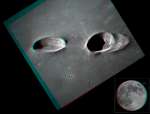 Messier Craters in Stereo
10.12.2009
Many bright nebulae and star clusters in planet Earth's sky are associated with the name of astronomer Charles Messier, from his famous 18th century catalog. His name is also given to these two large and remarkable craters on the Moon.
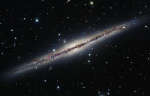 At the Edge of NGC 891
26.05.2012
This sharp cosmic portrait features NGC 891. The spiral galaxy spans about 100 thousand light-years and is seen almost exactly edge-on from our perspective. In fact, about 30 million light-years distant in the constellation Andromeda, NGC 891 looks a lot like our Milky Way.
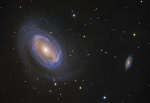 One Armed Spiral Galaxy NGC 4725
30.05.2013
While most spiral galaxies, including our own Milky Way, have two or more spiral arms, NGC 4725 has only one. In this sharp color composite image, the solo spira mirabilis seems to wind from a prominent ring of bluish, newborn star clusters and red tinted star forming regions.
|
January February March April May June July August September October |
|||||||||||||||||||||||||||||||||||||||||||||||||