
|
You entered: Milky Way
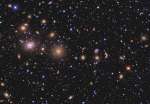 Galaxies of the Perseus Cluster
8.05.2009
This colorful telescopic skyscape is filled with galaxies that lie nearly 250 million light-years away, the galaxies of the Perseus cluster. Their extended and sometimes surprising shapes are seen beyond a veil of foreground stars in our own Milky Way.
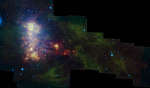 The Tail of the Small Magellanic Cloud
7.01.2010
A satellite galaxy of our Milky Way, the Small Magellanic Cloud is wonder of the southern sky, named for 16th century Portuguese circumnavigator Ferdinand Magellan. Some 200,000 light-years distant in the constellation Tucana...
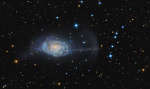 NGC 4651: The Umbrella Galaxy
15.04.2010
Spiral galaxy NGC 4651 is a mere 35 million light-years distant, toward the well-groomed constellation Coma Berenices. About 50 thousand light-years across, this galaxy is seen to have a faint umbrella-shaped structure (right) that seems to extend some 50 thousand light-years farther, beyond the bright galactic disk.
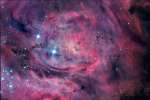 M8: The Lagoon Nebula
5.08.2010
This beautiful cosmic cloud is a popular stop on telescopic tours of the constellation Sagittarius. Eighteenth century cosmic tourist Charles Messier cataloged the bright nebula as M8. Modern day astronomers recognize the Lagoon Nebula as an active stellar nursery about 5,000 light-years distant, in the direction of the center of our Milky Way Galaxy.
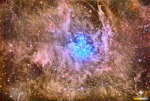 The Pleiades Deep and Dusty
14.11.2017
The well-known Pleiades star cluster is slowly destroying part of a passing cloud of gas and dust. The Pleiades is the brightest open cluster of stars on Earth's sky and can be seen from almost any northerly location with the unaided eye.
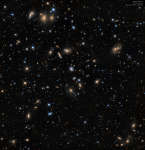 The Hercules Cluster of Galaxies
7.11.2020
These are galaxies of the Hercules Cluster, an archipelago of island universes a mere 500 million light-years away. Also known as Abell 2151, this cluster is loaded with gas and dust rich, star-forming spiral galaxies but has relatively few elliptical galaxies, which lack gas and dust and the associated newborn stars.
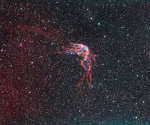 RCW 86: Historical Supernova Remnant
28.05.2022
In 185 AD, Chinese astronomers recorded the appearance of a new star in the Nanmen asterism. That part of the sky is identified with Alpha and Beta Centauri on modern star charts. The new star was visible for months and is thought to be the earliest recorded supernova.
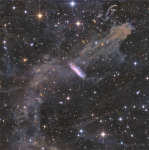 A Galaxy Beyond Stars, Gas, Dust
19.10.2022
Do we dare believe our eyes? When we look at images of space, we often wonder whether they are "real", and just as often the best answer varies. In this case, the scene appears...
 APOD: 2025 July 25 Б Twelve Years of Kappa Cygnids
25.07.2025
Meteors from the Kappa Cygnid meteor shower are captured in this time-lapse composite skyscape. The minor meteor shower, with a radiant not far from its eponymous star Kappa Cygni, peaks in mid-August, almost at the same time as the much better-known and better-observed Perseid meteor shower.
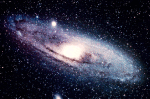 M31: The Andromeda Galaxy
24.07.1995
Andromeda is the nearest major galaxy to our own Milky Way Galaxy. Our Galaxy is thought to look much like Andromeda. Together these two galaxies dominate the Local Group of galaxies. The diffuse light from Andromeda is caused by the hundreds of billions of stars that compose it.
|
January February March April May June July August September October |
|||||||||||||||||||||||||||||||||||||||||||||||||