
|
You entered: nebula
 APOD: 2024 June 11 Б Colorful Stars and Clouds near Rho Ophiuchi
11.06.2024
Why is the sky near Antares and Rho Ophiuchi so colorful, yet dusty? The colors result from a mixture of objects and processes. Fine dust -- illuminated by starlight -- produces blue reflection nebulae. Gaseous clouds whose atoms are excited by ultraviolet starlight produce reddish emission nebulae. Backlit dust clouds block starlight and so appear dark.
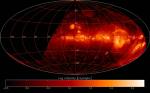 The Southern Sky in Warm Hydrogen
29.01.2002
A robotic telescope with red sunglasses in Chile has been photographing the entire southern sky for years. The result, shown above, is the most complete sky map of the most common visible light emitted from the most abundant element in our Galaxy: hydrogen. A very specific red color emitted by warm ionized hydrogen was observed.
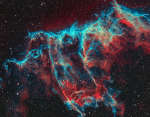 A Spectre in the Eastern Veil
1.11.2008
Menacing flying forms and garish colors are a mark of the Halloween season. They also stand out in this cosmic close-up of the eastern Veil Nebula. The Veil Nebula itself is a large supernova remnant, the expanding debris cloud from the death explosion of a massive star.
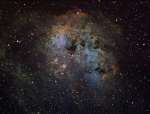 IC 410 and NGC 1893
17.01.2009
Dusty emission nebula IC 410 lies about 12,000 light-years away in the northern constellation Auriga. The cloud of glowing gas is over 100 light-years across, sculpted by stellar winds and radiation from embedded open star cluster NGC 1893.
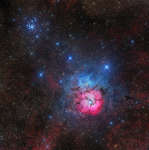 Messier 20 and 21
30.12.2019
The beautiful Trifid Nebula, also known as Messier 20, is easy to find with a small telescope in the nebula rich constellation Sagittarius. About 5,000 light-years away, the colorful study in cosmic contrasts shares this well-composed, nearly 1 degree wide field with open star cluster Messier 21 (top left).
 APOD: 2024 January 31 Б Camera Orion Rising
31.01.2024
What does Orion rising look like to a camera? During this time of the year, the famous constellation is visible to the southeast just after sunset. From most Earthly locations, Orion's familiar star pattern, highlighted by the three-stars-in-a-row belt stars, rises sideways.
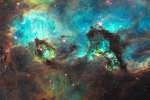 The Seahorse of the Large Magellanic Cloud
23.03.2009
To some it may look to some like a big space monster, but it is more big than monster. To others it may look like a grazing seahorse, but the dark object toward the image right is actually an inanimate pillar of smoky dust about 20 light years long.
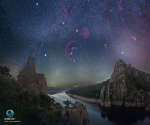 A Dark Winter Sky over MonfragЭe National Park in Spain
14.03.2017
You, too, can see a night sky like this. That is because MonfragЭe National Park in Spain, where this composite image was created, has recently had its night sky officially protected from potential future light pollution.
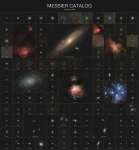 APOD: 2026 May 14 Б The Messier Catalog at Uniform Scale
14.05.2026
What are some of the most interesting astronomical objects you can see in the night sky? Armed with a good pair of binoculars or a small telescope, if you live in the Northern Hemisphere, you can look for the very popular objects in the Messier Catalog.
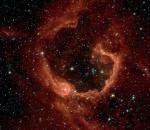 RCW 79: Stars in a Bubble
15.04.2005
A cosmic bubble of gas and dust, RCW 79 has grown to about 70 light-years in diameter, blown by the winds and radiation from hot young stars. Infrared light from the dust embedded in the nebula is tinted red in this gorgeous false-color view from the Spitzer Space Telescope.
|
January February March April May June July August |
||||||||||||||||||||||||||||||||||||||||||||||||||||||||