
|
You entered: Earth orbit
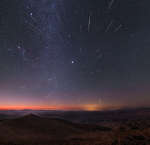 Geminid Meteors over Chile
23.12.2013
From a radiant point in the constellation of the Twins, the annual Geminid meteor shower rained down on planet Earth over the past few weeks. Recorded near the shower's peak over the night...
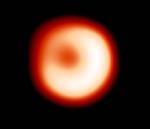 LkHa101: The Hole in the Doughnut
2.03.2001
You'd need a really big cup of coffee with this doughnut ... because the hole in the middle is about a billion kilometers across. Centered on the Sun, a circle that size would lie between the orbits of Mars and Jupiter.
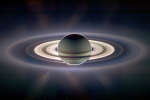 In the Shadow of Saturn
4.09.2011
In the shadow of Saturn, unexpected wonders appear. The robotic Cassini spacecraft now orbiting Saturn drifted in giant planet's shadow for about 12 hours in 2006 and looked back toward the eclipsed Sun. Cassini saw a view unlike any other.
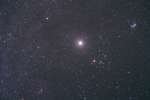 Bright Jupiter in Taurus
27.11.2012
That bright star you've recently noticed rising just after sunset isn't a star at all. It's Jupiter, the solar system's ruling gas giant. Bright Jupiter is nearing its December 3rd opposition when it will stand in Taurus, opposite the Sun in planet Earth's sky.
 In the Shadow of Saturn
16.10.2006
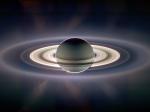
In the shadow of Saturn, unexpected wonders appear. The robotic Cassini spacecraft now orbiting Saturn recently drifted in giant planet's shadow for about 12 hours and looked back toward the eclipsed Sun. Cassini saw a view unlike any other.
 Churning Clouds on Jupiter
11.08.2020
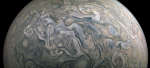
Where is Jupiter's ammonia? Gaseous ammonia was expected to be seen in Jupiter's upper atmosphere by the orbiting Juno spacecraft -- but in many clouds is almost absent. Recent Juno data, however, gives some clues: some high-level clouds appear to be home to an unexpected type of electrical discharge dubbed shallow lightning.
 In the Shadow of Saturn
11.01.2009
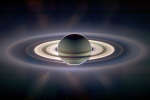
In the shadow of Saturn, unexpected wonders appear. The robotic Cassini spacecraft now orbiting Saturn recently drifted in giant planet's shadow for about 12 hours and looked back toward the eclipsed Sun. Cassini saw a view unlike any other.
 The Barren Moon
3.01.1998
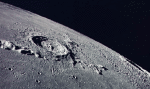
The above photo, taken as the Apollo 17 astronauts orbited the Moon in 1972, depicts the stark lunar surface around the Eratosthenes and Copernicus craters. Many similar images of a Moon devoid of life are familiar to denizens of the space age.
 In the Shadow of Saturn
13.11.2013
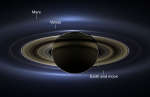
In the shadow of Saturn, unexpected wonders appear. The robotic Cassini spacecraft now orbiting Saturn drifted in giant planet's shadow earlier this year and looked back toward the eclipsed Sun. Cassini saw a unique and celebrated view.
 A High Energy Fleet
25.05.1997
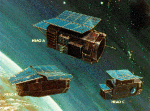
Looking like a fleet of futuristic starcruisers, NASA's highly successful series of High Energy Astrophysical Observatory (HEAO) spacecraft appear poised over planet Earth. Labeled A, B, and C in this vintage illustration, the spacebased telescopes were known as HEAO-1, HEAO-2, and HEAO-3 respectively.
|
January February March April May June July August September October |
|||||||||||||||||||||||||||||||||||||||||||||||||