
|
You entered: Milky Way
 APOD: 2024 May 1 Б IC 1795: The Fishhead Nebula
1.05.2024
To some, this nebula looks like the head of a fish. However, this colorful cosmic portrait really features glowing gas and obscuring dust clouds in IC 1795, a star forming region in the northern constellation Cassiopeia.
 APOD: 2025 May 7 Б Galaxy Wars: M81 versus M82
7.05.2025
In the upper left corner, surrounded by blue arms and dotted with red nebulas, is spiral galaxy M81. In the lower right corner, marked by a light central line and surrounded by red glowing gas, is irregular galaxy M82.
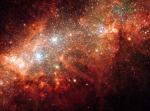 NGC 1569: Starburst in a Small Galaxy
5.02.2004
Grand spiral galaxies often seem to get all the glory, flaunting their young, bright, blue star clusters in beautiful, symmetric spiral arms. But small, irregular galaxies form stars too. In fact, as pictured here...
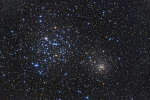 Open Star Clusters M35 and NGC 2158
3.01.2013
Open clusters of stars can be near or far, young or old, and diffuse or compact. Found near the plane of our Milky Way galaxy, they contain from 100 to 10,000 stars, all of which formed at nearly the same time. Bright blue stars frequently distinguish younger open clusters.
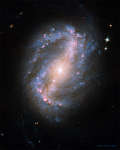 Barred Spiral Galaxy NGC 6217
21.02.2022
Many spiral galaxies have bars across their centers. Even our own Milky Way Galaxy is thought to have a modest central bar. Prominently barred spiral galaxy NGC 6217, featured here, was captured in spectacular detail in this image taken by the Advanced Camera for Surveys on the orbiting Hubble Space Telescope in 2009.
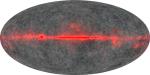 Universe Age from the Microwave Background
17.02.2003
The above sky map tells us the universe is 13.7 billion years old -- but how? At first look, one only sees the microwave glow of gas from our Milky Way Galaxy, coded red, and a spotty pattern of microwaves emitted from the early universe, coded in gray.
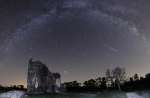 Perseid Prelude
12.08.2010
Each August, as planet Earth swings through dust trailing along the orbit of periodic comet Swift-Tuttle, skygazers can enjoy the Perseids Meteor Shower. The shower should build to its peak now, best seen from later tonight after moonset, until dawn tomorrow morning when Earth moves through the denser part of the wide dust trail.
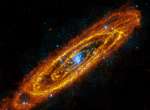 The Once and Future Stars of Andromeda
20.01.2011
The big, beautiful Andromeda Galaxy, aka M31, is a spiral galaxy a mere 2.5 million light-years away. Two space-based observatories have combined to produce this intriguing composite image of Andromeda, at wavelengths outside the visible spectrum. The remarkable view follows the locations of this galaxy's once and future stars.
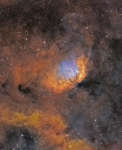 The Tulip in the Swan
14.11.2014
Framing a bright emission region this telescopic view looks out along the plane of our Milky Way Galaxy toward the nebula rich constellation Cygnus the Swan. Popularly called the Tulip Nebula the glowing cloud of interstellar gas and dust is also found in the 1959 catalog by astronomer Stewart Sharpless as Sh2-101.
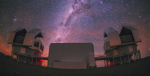 An Active Night over the Magellan Telescopes
21.02.2017
The night sky is always changing. Featured here are changes that occurred over a six hour period in late 2014 June behind the dual 6.5-meter Magellan Telescopes at Las Campanas Observatory in Chile.
|
January February March April May June July August September October |
|||||||||||||||||||||||||||||||||||||||||||||||||