
|
You entered: outer Galaxy
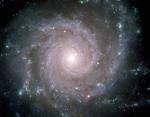 M74: The Perfect Spiral
4.10.2001
If not perfect, then this spiral galaxy is at least one of the most photogenic. An island universe of about 100 billion stars, 30 million light-years away toward the constellation Pisces, NGC 628 or M74 presents a gorgeous face-on view to earthbound astronomers.
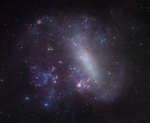 The Large Cloud of Magellan
19.12.2008
The 16th century Portuguese navigator Ferdinand Magellan and his crew had plenty of time to study the southern sky during the first circumnavigation of planet Earth. As a result, two fuzzy cloud-like objects easily...
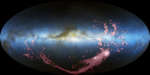 The Magellanic Stream
25.01.2010
Spanning the sky toward the majestic Clouds of Magellan is an unusual stream of gas: the Magellanic Stream. The origin of this gas remains unknown but likely hold a clue to origin and fate of our Milky Way's most famous satellite galaxies: the LMC and the SMC.
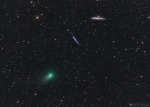 The Comet, the Whale, and the Hockey Stick
13.05.2021
Closest to the Sun on March 1, and closest to planet Earth on April 23, this Comet ATLAS (C/2020 R4) shows a faint greenish coma and short tail in this pretty, telescopic field of view.
 Dueling Bands in the Night
1.03.2022
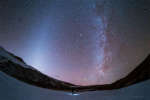
What are these two bands in the sky? The more commonly seen band is the one on the right and is the central band of our Milky Way galaxy. Our Sun orbits...
 SN Refsdal: The First Predicted Supernova Image
21.12.2015
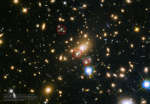
It's back. Never before has an observed supernova been predicted. The unique astronomical event occurred in the field of galaxy cluster MACS J1149.5+2223. Most bright spots in the featured image are galaxies in this cluster.
 Exploring the Antennae
11.02.2015
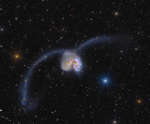
Some 60 million light-years away in the southerly constellation Corvus, two large galaxies are colliding. The stars in the two galaxies, cataloged as NGC 4038 and NGC 4039, very rarely collide in the course of the ponderous cataclysm, lasting hundreds of millions of years.
 M87 s Energetic Jet
1.11.2001
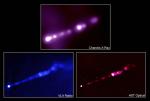
An energetic jet from the core of giant elliptical galaxy M87 stretches outward for 5,000 light-years. This monstrous jet appears in the panels above to be a knotted and irregular structure, dectected across the spectrum, from x-ray to optical to radio wavelengths.
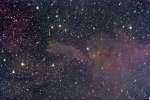 CG4: A Ruptured Cometary Globule
1.09.2008
Can a gas cloud grab a galaxy? It's not even close. The "claw" of this odd looking "creature" in the above photo is a gas cloud known as a cometary globule. This globule, however, has ruptured. Cometary globules are typically characterized by dusty heads and elongated tails.
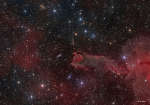 CG4: A Ruptured Cometary Globule
26.07.2021
Can a gas cloud grab a galaxy? It's not even close. The "claw" of this odd looking "creature" in the featured photo is a gas cloud known as a cometary globule. This globule, however, has ruptured. Cometary globules are typically characterized by dusty heads and elongated tails.
|
January February March April May June July August September October |
|||||||||||||||||||||||||||||||||||||||||||||||||