
|
You entered: time
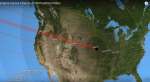 Eclipse Across America: Path Prediction Video
18.06.2017
Where will you be during the Eclipse across America? On August 21, the shadow of the Moon will cross the continental USA for the first time since 1979. The predicted path -- a certainty given modern astronomical knowledge -- is shown in the featured NASA video.
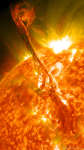 A Solar Filament Erupts
15.09.2018
What's happened to our Sun? Nothing very unusual -- it just threw a filament. Toward the middle of 2012, a long standing solar filament suddenly erupted into space producing an energetic Coronal Mass Ejection (CME).
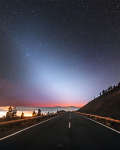 Zodiacal Road
23.07.2019
What's that strange light down the road? Dust orbiting the Sun. At certain times of the year, a band of sun-reflecting dust from the inner Solar System appears prominently just after sunset -- or just before sunrise -- and is called zodiacal light.
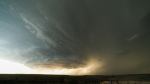 A Supercell Thunderstorm Over Texas
12.06.2021
Is that a cloud or an alien spaceship? It's an unusual and sometimes dangerous type of thunderstorm cloud called a supercell. Supercells may spawn damaging tornados, hail, downbursts of air, or drenching rain. Or they may just look impressive.
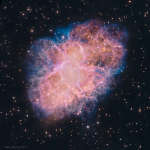 M1: The Crab Nebula
23.12.2021
The Crab Nebula is cataloged as M1, the first object on Charles Messier's famous 18th century list of things which are not comets. In fact, the Crab is now known to be a supernova remnant, debris from the death explosion of a massive star, witnessed by astronomers in the year 1054.
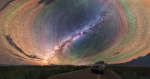 Colorful Airglow Bands Surround Milky Way
12.03.2022
Why would the sky glow like a giant repeating rainbow? Airglow. Now air glows all of the time, but it is usually hard to see. A disturbance however -- like an approaching storm -- may cause noticeable rippling in the Earth's atmosphere.
 The Clipper and the Comet
16.10.2024
NASA's Europa Clipper is now headed toward an ocean world beyond Earth. The large spacecraft is tucked into the payload fairing atop the Falcon Heavy rocket in this photo, taken at Kennedy Space Center the day before the mission's successful October 14 launch.
 APOD: 2025 September 24 Б GW250114: Rotating Black Holes Collide
23.09.2025
It was the strongest gravitational wave signal yet measured -- what did it show? GW250114 was detected by both arms of the Laser Interferometer Gravitational-wave Observatory (LIGO) in Washington and Louisiana USA earlier this year.
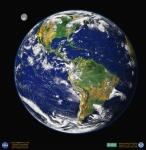 Blue Marble 2000
20.04.2000
This newly released digital portrait of our planet is reminiscent of the Apollo-era pictures of the "big blue marble" Earth from space. To create it, researchers at Goddard Space Flight Center's Laboratory...
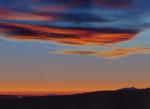 Mercury on the Horizon
12.04.2003
Have you ever seen the planet Mercury? Because Mercury orbits so close to the Sun, it never wanders far from the Sun in Earth's sky. If trailing the Sun, Mercury will be visible low on the horizon for only a short while before sunset.
|
January February March April May June July August |
||||||||||||||||||||||||||||||||||||||||||||||||||||||||