
|
You entered: Earth orbit
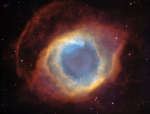 The Helix Nebula from Blanco and Hubble
12.10.2014
How did a star create the Helix nebula? The shapes of planetary nebula like the Helix are important because they likely hold clues to how stars like the Sun end their lives. Observations...
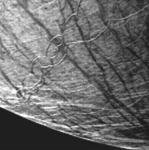 Ice Cusps on Europa
9.06.1998
Europa's icy crust has many unusual features. Pictured above is part of Europa's southern hemisphere photographed by the Galileo spacecraft currently orbiting Jupiter. Europa is one of the largest moons of Jupiter, and is thought to have oceans of water underneath its ice-covered surface.
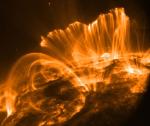 Coronal Rain, Solar Storm
15.11.2000
In this picture, the Sun's surface is quite dark. A frame from a movie recorded on November 9th by the orbiting TRACE telescope, it shows coronal loops lofted over a solar active region.
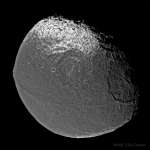 APOD: 2023 February 26 Б Saturns Iapetus: Moon with a Strange Surface
26.02.2023
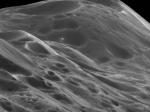
What would make a moon look like a walnut? A strange ridge that circles Saturn's moon Iapetus's equator, visible near the bottom of the featured image, makes it appear similar to a popular edible nut.
 4000 Kilometers Above Saturns Iapetus
19.09.2007
What does the surface of Saturn's mysterious moon Iapetus look like? To help find out, the robotic Cassini spacecraft now orbiting Saturn was sent soaring last week just 2,000 kilometers from the unique equatorial ridge of the unusual walnut-shaped two-toned moon.
 Mars: A Sheer Close Up
13.11.1997
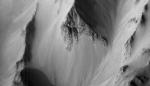
As the Mars Global Surveyor spacecraft maneuvers toward its final mapping orbit, its cameras have been producing some sharp views of Mars. At a resolution of better than 30 feet per pixel, this image...
 Close up of the Great Red Spot
15.07.2017
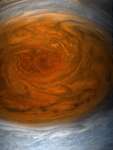
On July 11, the Juno spacecraft once again swung near to Jupiter's turbulent cloud tops in its looping 53 day orbit around the Solar System's ruling gas giant. About 11 minutes after perijove 7, its closest approach on this orbit, it passed directly above Jupiter's Great Red Spot.
 The Mysterious Methane of Mars
21.12.2014
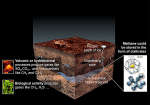
What's creating methane on Mars? Recent measurements from the robotic Curiosity rover currently rolling across Mars indicate a surprising 10-fold increase in atmospheric methane between measurements only months apart. Life is a major...
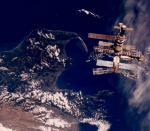 Mir Dreams
18.02.2006
This dream-like image of Mir was recorded by astronauts as the space shuttle orbiter Atlantis approached the Russian space station prior to docking during the STS-76 mission in 1996. Sporting spindly appendages and solar...
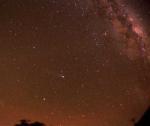 Comet Hyakutake and the Milky Way
17.08.1998
Two years ago, the Great Comet of 1996, Comet Hyakutake, inched across our northern sky during its long orbit around the Sun. Visible above as the bright spot with the faint tail near...
|
January February March April May June July August September October |
|||||||||||||||||||||||||||||||||||||||||||||||||