
|
You entered: ESO
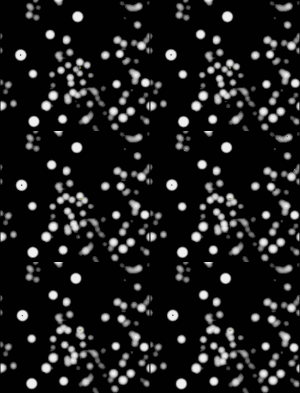 Sgr A*: Fast Stars Near the Galactic Center
14.01.2007
Why are these stars moving so fast? Shown above is a time-lapse movie in infrared light detailing how stars in the central light-year of our Galaxy have moved over the past eight years.
 Beta Pictoris Revisited
28.11.1997
In the early 1980s, Beta Pictoris became one of the most important stars in the sky. Satellite and ground-based telescopic observations revealed the presence of a surrounding outer disk of material and an inner "clear" zone about the size of our solar system - strong evidence for the formation of planets.
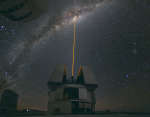 A Laser Strike at the Galactic Center
1.12.2013
Why are these people shooting a powerful laser into the center of our Galaxy? Fortunately, this is not meant to be the first step in a Galactic war. Rather, astronomers at the Very Large Telescope (VLT) site in Chile are trying to measure the distortions of Earth's ever changing atmosphere.
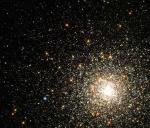 M80: A Dense Globular Cluster
7.07.1999
If our Sun were part of M80, the night sky would glow like a jewel box of bright stars. M80, also known as NGC 6093, is one of about 250 globular clusters that survive in our Galaxy.
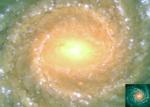 Spiral Galaxy NGC 1232
30.09.1998
Galaxies are fascinating not only for what is visible, but for what is invisible. Grand spiral galaxy NGC 1232, recently captured in detail by the new Very Large Telescope, is a good example.
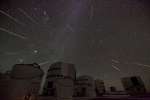 When Gemini Sends Stars to Paranal
15.12.2012
From a radiant point in the constellation of the Twins, the annual Geminid meteor shower rained down on planet Earth this week. Recorded near the shower's peak in the early hours of December...
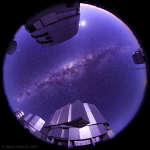 A Milky Way Dawn
29.03.2014
As dawn broke on March 27, the center of the Milky Way Galaxy stood almost directly above the European Southern Observatory's Paranal Observatory. In the dry, clear sky of Chile's Atacama desert...
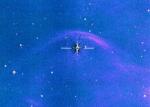 Runaway Star
27.11.1999
Runaway stars are massive stars traveling rapidly through interstellar space. Like a ship plowing through the interstellar medium, runaway star HD 77581 has produced this graceful arcing bow wave or "bow shock" - compressing the gaseous material in its path.
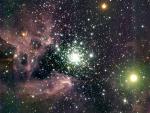 NGC 3603: An Active Star Cluster
18.10.1999
NGC 3603 is home to a massive star cluster, thick dust pillars, and a star about to explode. The central open cluster contains about 2000 bright stars, each of which is much brighter and more massive than our Sun.
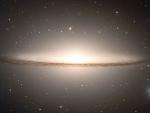 The Sombrero Galaxy from VLT
28.02.2000
Why does the Sombrero Galaxy look like a hat? Reasons include the Sombrero's unusually large and extended central bulge of stars, and dark prominent dust lanes that appear in a disk that we see nearly edge-on. Billions of old stars cause the diffuse glow of the extended central bulge.
|
January February March April May June July August September October |
|||||||||||||||||||||||||||||||||||||||||||||||||