
|
You entered: Galactic Center
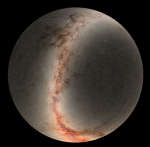 Pan STARRS Across the Sky
5.04.2019
This astronomical sky spanning view is a mosaic from the Pan-STARRS observatory. The images were recorded with its 1.8 meter telescope at the summit of Haleakala on planet Earth's island of Maui. In fact, Earth's north celestial pole is centered in this across-the-sky projection.
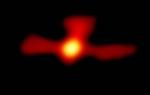 A Galactic Cloud of Antimatter
1.05.1997
The center of our Milky Way Galaxy is full of surprises. Its latest spectacular is a mysterious cloud glowing in gamma rays produced by annihilating antimatter particles! Star Trek fans are all too familiar...
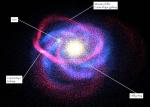 Canis Major Dwarf: A New Closest Galaxy
17.11.2003
What is the closest galaxy to the Milky Way? The new answer to this old question is the Canis Major dwarf galaxy. For many years astronomers thought the Large Magellan Cloud (LMC) was closest, but its title was supplanted in 1994 by the Sagittarius dwarf galaxy.
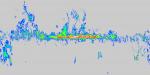 Milky Way Molecule Map
30.04.1997
Where are the Milky Way's gas clouds and where are they going? Stars form in gas clouds, and the motion of gas clouds tell us about the size and rotation speed of our own Milky Way Galaxy.
 Four Lasers over Mauna Kea
23.06.2014
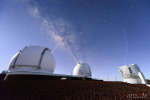
Are lasers from giant telescopes being used to attack the Galactic center? No. Lasers shot from telescopes are now commonly used to help increase the accuracy of astronomical observations. In some sky locations, Earth...
 NGC 1316: After Galaxies Collide
4.04.2005
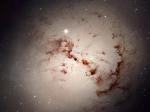
How did this strange-looking galaxy form? Astronomers turn detectives when trying to figure out the cause of unusual jumbles of stars, gas, and dust like NGC 1316. A preliminary inspection indicates that NGC 1316 is an enormous elliptical galaxy that includes dark dust lanes usually found in a spiral.
 Our Galaxy in Stars, Gas, and Dust
27.09.1999
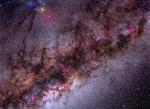
The disk of our Milky Way Galaxy is home to hot nebulae, cold dust, and billions of stars. The red nebulae visible in the above contrast-enhanced picture are primarily emission nebulae, glowing clouds of hydrogen gas heated by nearby, bright, young stars.
 Our Galaxys Magnetic Field from Planck
26.01.2015
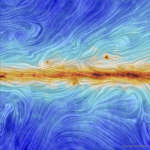
What does the magnetic field of our Galaxy look like? It has long been known that a modest magnetic field pervades our Milky Way Galaxy because it is seen to align small dust grains that scatter background light. Only recently, however, has the Earth-orbiting Planck satellite made a high-resolution map of this field.
 Open Star Clusters M35 and NGC 2158
27.02.2025
Framed in this single, starry, telescopic field of view are two open star clusters, M35 and NGC 2158. Located within the boundaries of the constellation Gemini, they do appear to be side by side. Its stars concentrated toward the upper right, M35 is relatively nearby, though.
 Milky Way Rising
1.12.2023
The core of the Milky Way is rising beyond the Chilean mountain-top La Silla Observatory in this deep night skyscape. Seen toward the constellation Sagittarius, our home galaxy's center is flanked...
|
January February March April May June July August September October |
|||||||||||||||||||||||||||||||||||||||||||||||||