
|
You entered: Observatory
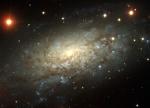 NGC 3621: Far Beyond the Local Group
5.06.2002
Far beyond the local group of galaxies lies NGC 3621, some 22 million light-years away. Found in the serpentine southern constellation Hydra, the loose spiral arms of this gorgeous island universe are loaded with luminous young star clusters and dark dust lanes.
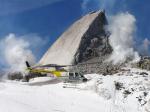 Rock Slab Growing at Mt St Helens Volcano
9.05.2006
A new rock slab is growing at more than one meter a day on the Mt. St. Helens volcano in Washington, USA. The rock slab, growing since last November, now extends about 100 meters out from one of the volcano's craters. A recently made time lapse movie shows the rock slab growing.
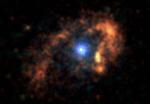 Eta Carinae in X Rays
11.10.1999
Eta Carinae is the one of the most luminous star systems in our Galaxy, radiating millions of times more power than our Sun. Eta Carinae is also one of the strangest star systems known, brightening and fading greatly since the early 1800s.
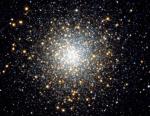 Hydrogen, Helium, and the Stars of M10
30.06.2001
Stars like the Sun use hydrogen for fuel, "burning" hydrogen into helium at their cores through nuclear fusion. But what happens when that hydrogen runs out? For a while, hydrogen burns in a shell surrounding the stellar core and the star expands to become a red giant.
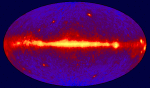 The Gamma Ray Sky
21.03.1998
What if you could "see" gamma rays? If you could, the sky would seem to be filled with a shimmering high-energy glow from the most exotic and mysterious objects in the Universe.
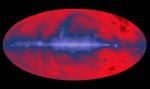 The Radio Sky: Tuned to 408MHz
5.02.2005
Tune your radio telescope to 408MHz (408 million cycles per second) and check out the Radio Sky! In the 1970s large dish antennas at three radio observatories, Jodrell Bank, MPIfR, and Parkes Observatory, were used to do just that - the data were combined to map the entire sky.
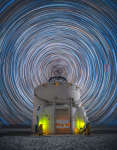 APOD: 2026 August 28 Б The Sky Turns Above Paranal
28.08.2026
At the latitude of ESO's Paranal Observatory in Chile, about 25 degrees south, Earth's rotation moves the planet's surface eastward at over 1,500 kilometers per hour. And while that's faster than the speed of sound at sea level, the motion is imperceptible.
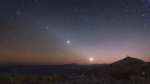 Planets of the Morning
26.11.2015
Planet Earth's horizon stretches across this recent Solar System group portrait, seen from the southern hemisphere's Las Campanas Observatory. Taken before dawn it traces the ecliptic with a line-up familiar to November's early morning risers.
 Lyrids in Southern Skies
27.04.2017
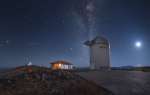
Earth's annual Lyrid meteor shower peaked before dawn on April 22nd, as our fair planet plowed through dust from the tail of long-period comet Thatcher. Seen from the high, dark, and dry Atacama desert a waning crescent Moon and brilliant Venus join Lyrid meteor streaks in this composited view.
 Swift RocketCam
24.12.2004
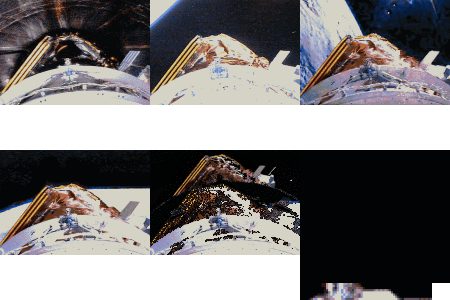
A forward-facing RocketCam (TM) mounted inside the payload fairing of a Delta II rocket captured these dramatic video frames on November 20th -- as the Swift satellite observatory journeyed to an orbit 600 kilometers above planet Earth. Some frames were interpolated to correct for transmission problems.
|
January February March April May June July August September October |
|||||||||||||||||||||||||||||||||||||||||||||||||